
Your child just got diagnosed with Autism Spectrum Disorder. The paediatrician handed you a list of therapies. You Googled “OT for autism” at 2am. And now you’re drowning in information but starving for clarity.
Here’s what you actually need to know.
Occupational therapy is one of the most effective interventions for children with ASD. Not because it “cures” autism. It doesn’t. OT works because it gives your child the specific skills they need to function, at home, at school, and in the community.
This page breaks down exactly what OT does for autism, how it compares to other therapies, what a session looks like, and what it costs in Malaysia. No fluff. Just answers.
What Does an Occupational Therapist Actually Do for Autism?
An OT for autism targets four core areas:
1. Sensory Processing Most children with ASD experience sensory input differently. Some are hypersensitive, covering ears at normal sounds, gagging at food textures, melting down in busy shopping malls. Others are hyposensitive, seeking constant movement, crashing into furniture, not noticing pain.
An OT identifies your child’s unique sensory profile. Then they design specific activities to help your child regulate sensory input. This is not random play. It is targeted, measurable intervention.
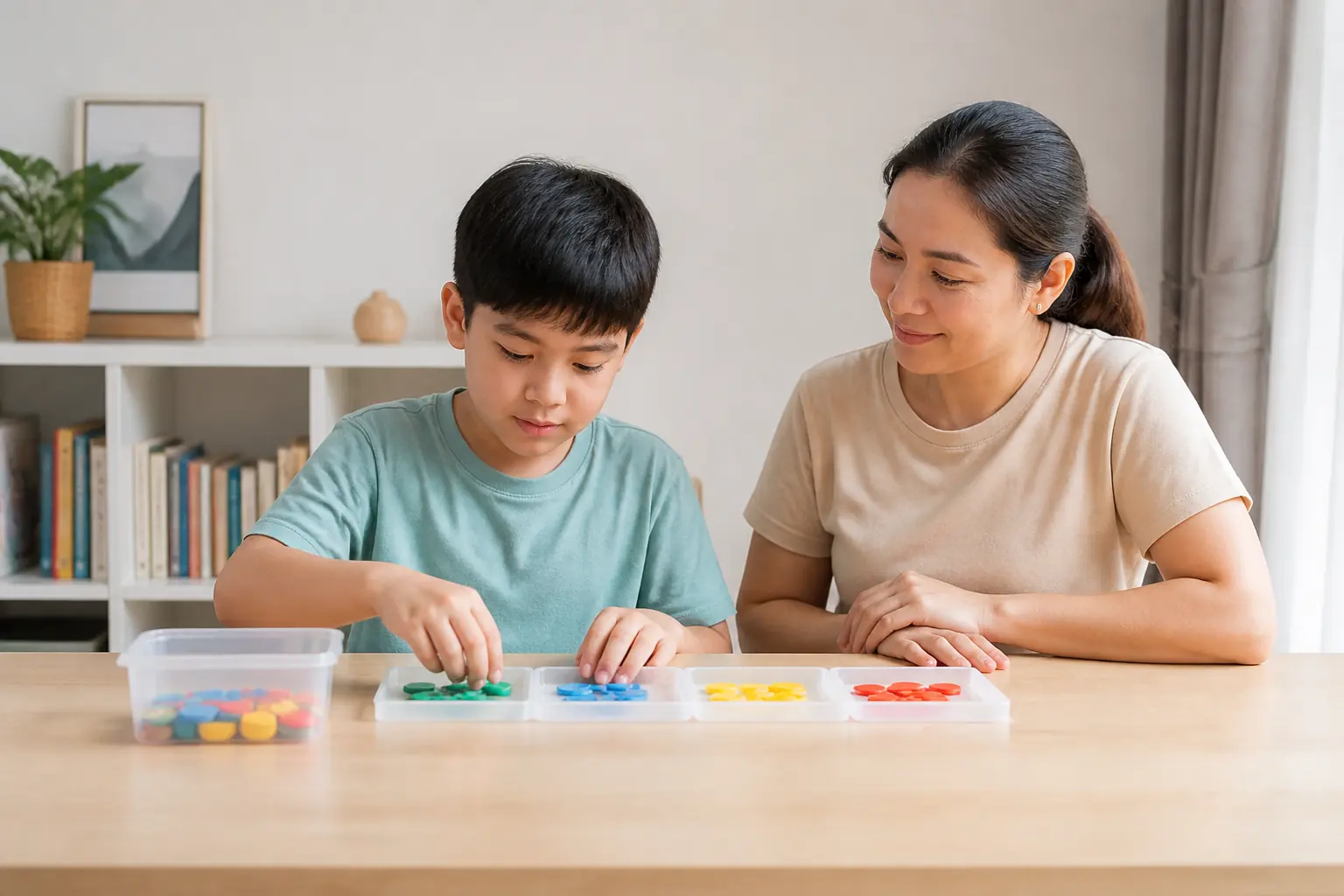
2. Fine Motor Skills Holding a pencil. Buttoning a shirt. Using scissors. Opening a lunch box. These tasks require hand strength, coordination, and motor planning, areas where many children with autism struggle. An OT builds these skills through structured activities that progress from simple to complex.
3. Self-Care Independence Brushing teeth. Bathing. Getting dressed. Eating with utensils. These are the daily battles that exhaust parents. An OT breaks each task into teachable steps, uses visual schedules, and creates routines your child can follow independently.
4. Social Participation Taking turns. Sitting in a circle during class. Playing with peers without melting down. OTs work on the underlying sensory and motor foundations that make social participation possible. When a child can regulate their body, they can engage with others.
How Do I Know My Child with Autism Needs OT?
Not every child with ASD needs occupational therapy. But most do.
Your child likely needs OT if they:
- Cover ears, avoid certain textures, or melt down in busy environments
- Struggle to hold a crayon, use scissors, or manage buttons and zippers
- Cannot brush teeth, dress, or eat without significant help past age 4
- Have difficulty sitting still during meals or classroom activities
- Crash into things, seek constant movement, or seem unaware of their body in space
- Resist transitions between activities (going from play to bath time triggers a meltdown)
- Avoid playground equipment that other children enjoy
- Struggle to follow multi-step instructions for daily tasks
If three or more apply, book an OT assessment. Do not wait.
What Happens at the First OT Session? A Complete Walkthrough
Knowing what to expect removes anxiety. Here is a step-by-step breakdown of your child’s first occupational therapy session in Malaysia.
Before the session (15-30 minutes) You complete intake forms. Medical history. School reports. Your concerns. Some clinics send these digitally before the appointment. Bring any reports from your paediatrician, psychologist, or previous therapists.
Assessment phase (30-45 minutes) The OT observes your child in a structured play environment. They assess:
- How your child responds to touch, sound, light, and movement
- Hand strength, coordination, and pencil grip
- Ability to follow instructions and sequence tasks
- Self-care skills (can they unbutton, unzip, open containers?)
- How they handle transitions between activities
The OT may use standardised assessments like the Sensory Profile-2 or the Bruininks-Oseretsky Test. Your child does not need to “perform.” The OT gathers information through observation and play.
Goal-setting discussion (15-20 minutes) The OT sits with you (without your child if possible) and explains:
- What they observed
- Your child’s sensory profile (avoiding? seeking? mixed?)
- Specific areas that need intervention
- Recommended frequency (usually 1-2 sessions per week)
- Measurable 3-month goals
You should leave the first session with a clear picture: here is where your child is, here is where we want them to be, and here is how we get there.
Cost of the initial assessment: RM150 to RM350 at private clinics. RM5 to RM30 at government hospitals (with referral).
OT vs ABA for Autism: Which Does Your Child Need?
This is the question every parent of a child with ASD asks. Here is an honest comparison.
| Factor | Occupational Therapy (OT) | Applied Behaviour Analysis (ABA) |
|---|---|---|
| Core focus | Sensory processing, motor skills, self-care, functional independence | Behaviour modification, communication, social skills through reinforcement |
| Approach | Identifies WHY a child struggles (sensory/motor root causes) and builds underlying skills | Identifies WHAT behaviours to increase or decrease and uses reinforcement to shape them |
| Session length | 45–60 minutes, 1–2x per week | 2–6 hours per day, 3–5x per week (intensive model) |
| Session style | Play-based, sensory-motor activities, real-life task practice | Structured trials, natural environment training, data-driven |
| Typical duration | 6–24 months | 1–3 years |
| Cost in Malaysia | RM120–RM280 per session | RM150–RM400 per hour (intensive programs RM3,000–RM8,000/month) |
| Best for | Sensory meltdowns, motor delays, self-care struggles, handwriting issues | Communication deficits, challenging behaviours, social skill building |
| Availability in MY | Widely available, government and private | Limited, mostly private centres in KL, Penang, JB |
The real answer: Most children with autism benefit from both. OT and ABA target different things. OT addresses the sensory and motor foundations. ABA addresses behaviour and communication. They complement each other.
If you can only afford one, choose based on your child’s biggest barrier. If your child melts down from sensory overload and cannot dress themselves, start with OT. If your child has limited speech and significant behavioural challenges, start with ABA.
What Does OT for Autism Cost in Malaysia?
Costs vary by setting and location.
Government hospitals (with referral)
- Assessment: RM5–RM30
- Follow-up sessions: RM5–RM30
- Wait time: 2–8 weeks for first appointment
- Session frequency: Typically fortnightly or monthly (high demand, limited slots)
Private OT clinics
- Initial assessment: RM150–RM350
- Follow-up sessions: RM120–RM280
- Wait time: 1–2 weeks
- Session frequency: Weekly or twice weekly (you choose)
Community-based centres (PDK, NGOs)
- Fees: RM0–RM80 (subsidised)
- Availability: Limited. Not all centres have qualified OTs.
- Best for: Families who cannot afford private but face long government wait times
Insurance coverage Some Malaysian private insurance plans cover OT under rehabilitation or allied health benefits. Check your policy for:
- Annual rehabilitation limits (common: RM1,000–RM5,000)
- Requirement for specialist referral letter
- Whether the OT needs to be panel-listed
How to Decide: Government vs Private OT for Your Child with Autism
| Factor | Government Hospital OT | Private OT Clinic |
|---|---|---|
| Cost per session | RM5–RM30 | RM120–RM280 |
| Wait for first appointment | 2–8 weeks | 1–2 weeks |
| Session frequency | Fortnightly to monthly | Weekly to twice weekly |
| Session length | 30–45 minutes | 45–60 minutes |
| Therapist continuity | May rotate therapists | Same therapist typically |
| Parent involvement | Limited (waiting room) | High (often in-session coaching) |
| Home program provided | Sometimes | Almost always |
| Location flexibility | Fixed hospital location | Some offer home visits |
Many families in Malaysia do both. They see a government OT every 2 weeks for low-cost sessions. They supplement with a private OT weekly for faster progress. This is a smart strategy if your budget allows it.
Milestones: What Progress Looks Like
Every child is different. But here is a general timeline for children with autism receiving weekly OT:
Weeks 1–4: Foundation
- Child becomes comfortable with the OT and the clinic environment
- OT completes detailed assessment and sensory profile
- Parent receives home activity program
- Early signs: child tolerates previously avoided textures or sounds for a few seconds longer
Weeks 5–12: Early Gains
- Sensory meltdowns reduce in frequency or intensity
- Child begins to tolerate grooming activities (hair brushing, nail cutting) with less resistance
- Fine motor improvements: stronger grip, more controlled crayon use
- Child follows 2-step self-care routines with visual support
Months 3–6: Functional Progress
- Independent self-care tasks emerge (puts on shirt, uses spoon consistently)
- Handwriting readiness improves (pre-writing shapes, letter formation)
- Child participates in classroom activities with fewer sensory breaks needed
- Transitions between activities become smoother
Months 6–12: Independence Building
- Child dresses independently with minimal prompts
- Manages school bag, lunch box, and stationery without help
- Participates in group activities and playground play
- Sensory regulation strategies become self-initiated
Months 12–24: Generalisation
- Skills transfer to new environments (new classroom, holiday trips, relatives’ homes)
- Child self-advocates (“it’s too loud, I need a break”)
- Fine motor skills support academic work (writing speed and legibility improve)
- Parent reports measurable reduction in daily stress and assistance needed
Keep a log. Take videos monthly. Progress can be invisible when you see your child every day. Monthly videos show you changes you would otherwise miss.
What to Look for in an OT for Autism in Malaysia
Not all OTs have the same experience with ASD. When searching, ask:
- How many children with autism do you currently see? Look for at least 5 active ASD cases.
- What sensory integration training have you completed? Look for Ayres Sensory Integration (ASI) certification or equivalent.
- Do you provide a home program? This is non-negotiable. Progress depends on what happens between sessions.
- How do you involve parents in sessions? Parent coaching accelerates progress by 40% compared to drop-off-only sessions.
- How do you measure progress? The OT should use goal attainment scaling or standardised reassessments every 3 months.
Finding an OT for Autism Near You
We are Malaysia’s #1 dedicated occupational therapy directory. It covers all 16 states and territories, from Perlis to Sabah.
Every listed therapist includes their experience areas, qualifications, languages spoken, and whether they accept insurance. You can filter by location, specialisation in autism, and session type (clinic visit or home visit).
Find an Autism-Experienced OT Near You
Your child’s diagnosis is not the end of the road. It is the starting point. OT gives your child practical skills for real life. The earlier you start, the faster they progress.
Have questions? Reach out on WhatsApp and our team will help you find the right match.