
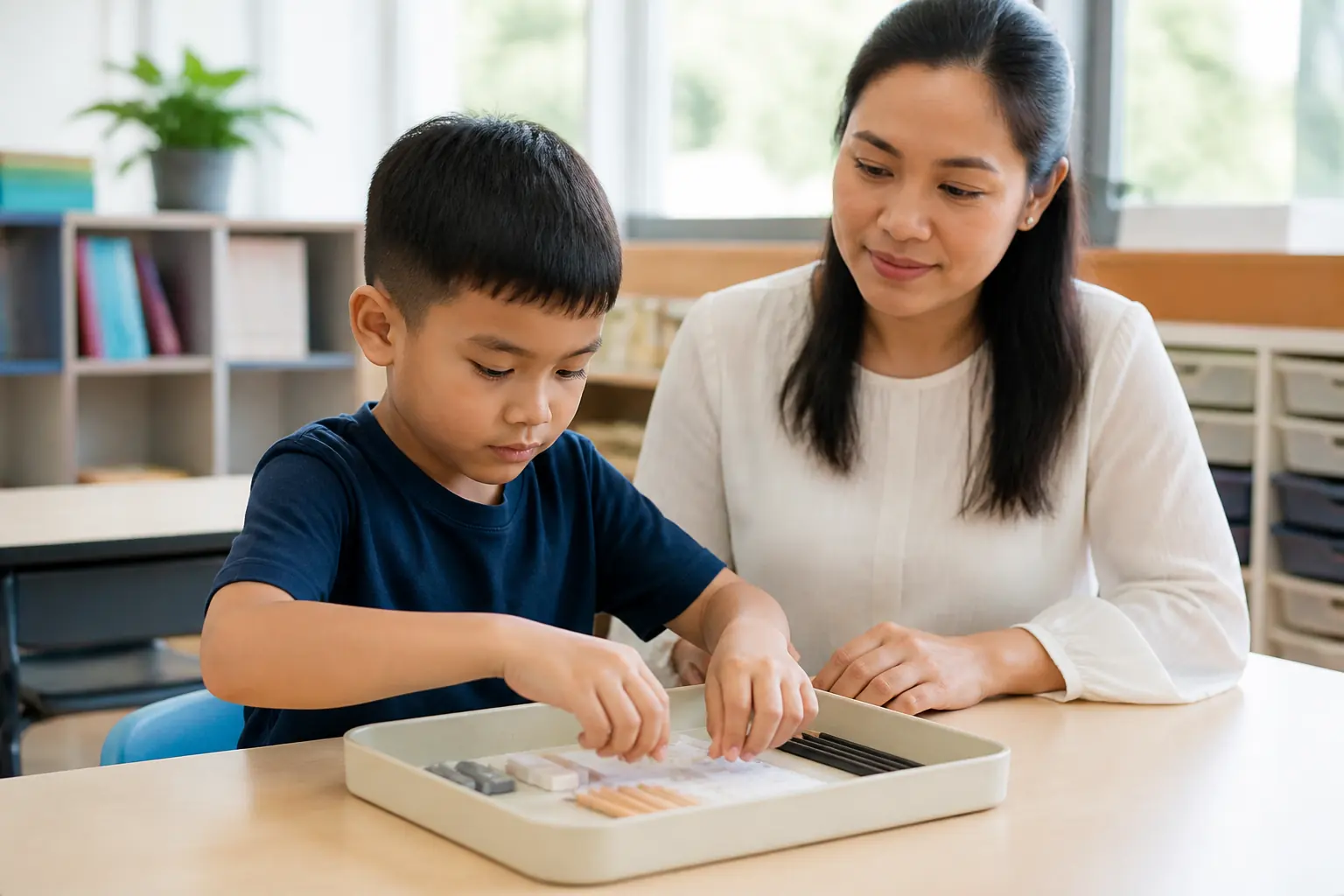
The teacher says your child’s handwriting is messy. You’ve tried everything: extra practice, handwriting workbooks, rewards, punishments, different pencils. Nothing works. Your child writes slowly, presses too hard, can’t stay on the line, and the letters are inconsistent in size and shape.
Is this laziness? Stubbornness? Not trying hard enough?
Probably none of these. Research from the American Journal of Occupational Therapy (2012) found that 10-30% of school-age children have handwriting difficulties significant enough to affect academic performance. These children aren’t refusing to write neatly, they physically cannot produce legible writing because one or more underlying skills are underdeveloped.
An occupational therapist identifies which specific skill is the bottleneck and targets it directly. More handwriting practice without fixing the underlying cause is like running laps to fix a broken shoe, more effort, same problem.
Worried about your child’s handwriting? Get an OT assessment.
The Skills Behind Handwriting
Handwriting requires at least seven different skills working together. A problem in any one of them produces messy writing:
1. Fine Motor Strength
The small muscles of the hand need enough strength to control a pencil through thousands of strokes per school day. Signs of weakness:
- Pressing too hard (compensating for poor control with force)
- Pressing too lightly (insufficient finger strength)
- Hand fatigue after a few lines of writing
- Shaking or trembling hand during writing
- Avoiding writing tasks entirely
A 2018 study in the Journal of Hand Therapy found that children with handwriting difficulties had 20-30% less pinch strength than peers with normal handwriting.
2. Pencil Grip
The mature tripod grip (thumb, index, middle finger) provides the most efficient control. But grip problems aren’t just about which fingers hold the pencil:
| Grip Issue | What It Looks Like | Effect on Writing |
|---|---|---|
| Thumb wrap | Thumb crosses over index finger | Blocks finger movement, forces whole-hand writing |
| Fisted grip | All fingers wrapped around pencil | No finger control, arm and shoulder do all the work |
| Extended fingers | Fingers straight, not bent | No fine control, excessive pressure |
| Finger-wrap | Four fingers gripping pencil | Inefficient, fatiguing |
| Thumb tuck | Thumb pressed against side of hand | Unstable grip, inconsistent pressure |
Important: not every non-tripod grip needs fixing. A 2012 study in the American Journal of Occupational Therapy found that alternative grips (lateral tripod, quadrupod) produce equivalent handwriting quality in many children. The OT assesses whether the grip is functional, not whether it matches a textbook picture.
3. Visual-Motor Integration
This is the ability to coordinate what the eyes see with what the hands do. The brain must translate the visual image of a letter into a motor plan for producing it. Signs of visual-motor problems:
- Letters that look nothing like the model being copied
- Difficulty copying shapes or patterns
- Inconsistent letter formation (writes ‘a’ differently each time)
- Inability to stay within lines or borders
- Poor spacing between words
The Beery-Buktenica VMI test is the gold standard assessment tool. OTs use it to measure visual-motor integration and determine whether it’s the primary bottleneck.
4. Motor Planning (Praxis)
Motor planning is the ability to figure out how to move your body to accomplish a new task. Children with motor planning difficulties (dyspraxia) know what a letter should look like but can’t organise the sequence of movements to produce it. Signs:
- Each letter looks like it’s being written for the first time
- Extremely slow writing despite practice
- Inconsistent letter formation
- Difficulty learning new letter forms
- Better at copying than writing from memory
5. In-Hand Manipulation
The ability to move objects within one hand without using the other hand. Necessary for adjusting pencil position, turning a pencil to erase, and maintaining grip during long writing tasks. Children with poor in-hand manipulation frequently stop writing to readjust their pencil.
6. Bilateral Coordination
One hand writes. The other hand stabilises the paper. Children with bilateral coordination difficulties can’t separate the two roles:
- Paper slides around while writing
- Child holds paper with chin, elbow, or mouth instead of non-dominant hand
- Writing drifts across the page because the paper isn’t stabilised
7. Postural Stability
Writing requires a stable core and shoulder girdle. The proximal muscles (trunk, shoulder) provide a stable base for the distal muscles (fingers) to work precisely. Signs of postural instability affecting handwriting:
- Slouching over the desk
- Head resting on non-dominant arm
- Wrapping legs around chair legs for stability
- Writing quality deteriorates within minutes as fatigue sets in
- Better handwriting when standing at a vertical surface than sitting at a desk
Find a paediatric OT for handwriting
What the OT Assessment Reveals
The OT evaluates all seven skill areas through standardised tests and clinical observation:
- Grip analysis: Which grip pattern, is it functional, does it cause fatigue?
- Strength testing: Pinch strength, grip strength, finger isolation
- VMI testing: Beery VMI or similar standardised tool
- Writing sample analysis: Letter formation, sizing, spacing, alignment, speed
- Postural observation: Core stability, shoulder stability, sitting endurance
- Functional observation: How the child actually writes in a natural setting
The assessment takes 45-60 minutes and costs RM150-300 at private OT clinics in Malaysia.
How OT Fixes Handwriting
Treatment targets the specific bottleneck identified in the assessment:
For weak hands: Playdough, theraputty, clothespin games, tearing paper, spray bottles, tong activities. These are not random, each targets specific muscle groups used in pencil control.
For poor VMI: Drawing within mazes, connecting dots, copying patterns of increasing complexity, writing on different surfaces (whiteboard, sand tray, finger paint).
For motor planning: Multi-sensory letter practice, forming letters in sand, with finger paint, in shaving cream, with large arm movements in the air, then progressively smaller until pencil and paper. The variety of sensory input strengthens the motor plan.
For postural instability: Core strengthening through play, animal walks, wheelbarrow walking, prone activities on a therapy ball. These don’t look like handwriting therapy, but they build the foundation that makes handwriting possible.
For grip: Grip modification tools (pencil grips from RM5-15), short pencil technique (broken crayons force tripod grip), vertical surface writing to promote wrist extension.
Treatment typically requires 8-16 weekly sessions. Most children show measurable improvement within 8 sessions. A 2019 study in OTJR: Occupation, Participation and Health found that OT-based handwriting intervention produced significant improvement in legibility and speed within 10 sessions.
Frequently Asked Questions
At what age should I worry about handwriting? By age 6-7 (Standard 1 in Malaysia), children should produce legible letters with consistent sizing. Before that, messy writing is developmentally normal. If handwriting is still illegible by mid-Standard 1 despite practice, get an OT assessment.
Should my child switch to typing instead? For some children with severe motor difficulties (such as dyspraxia or cerebral palsy), typing is the more functional option. But for most children with handwriting difficulties, the underlying skills can be improved with OT. Typing should be introduced as a supplement, not a replacement, unless the OT recommends otherwise.
Will my child outgrow messy handwriting? Some children do, if the problem is simply developmental immaturity. But if the problem is visual-motor integration, motor planning, or muscle weakness, these don’t self-correct with age. They persist into adulthood unless addressed through targeted intervention.
Messy Handwriting Has a Cause. The Cause Has a Fix.
Handwriting is not about effort, it’s about skill. When the underlying skills are weak, no amount of practice produces clean writing. An OT identifies the weak link and strengthens it. Then the practice starts producing results.
Chat with us on WhatsApp to find a paediatric OT for handwriting assessment, anywhere in Malaysia.