
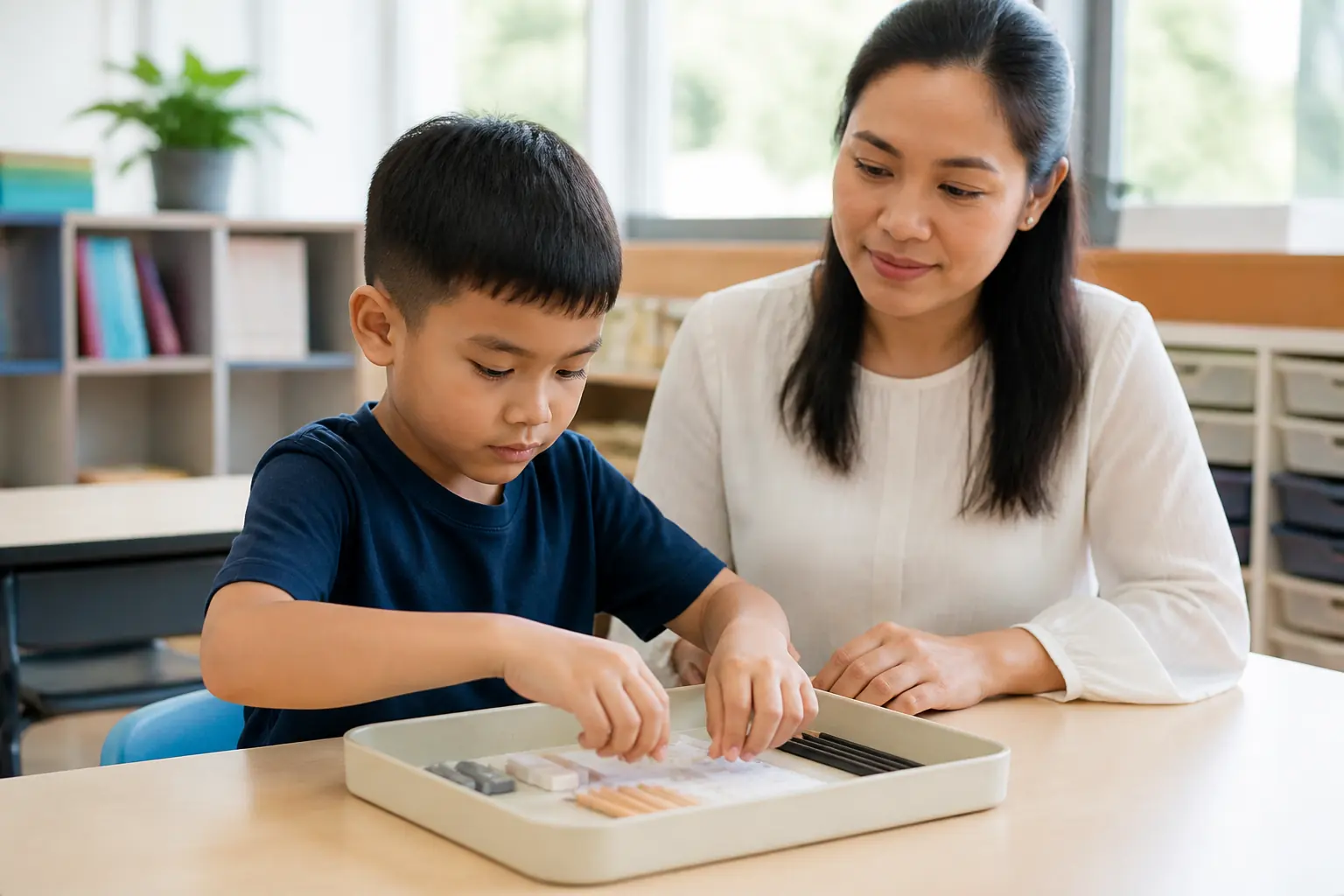
The teacher calls again. Your child can’t sit still. Loses their pencil case twice a week. Takes 45 minutes to copy three sentences from the board. Gets into trouble for “not paying attention” despite trying their hardest. The paediatrician prescribes methylphenidate. It helps with focus, but your child still can’t write legibly, still can’t organise their bag, still melts down after school.
That’s because medication addresses attention. It doesn’t build the underlying skills that ADHD disrupts. Occupational therapy does.
ADHD affects an estimated 3-5% of Malaysian school-age children, roughly 300,000 students. Of those, only a fraction receive OT, because most parents and even some doctors don’t know that OT has a role in ADHD management. It does. A significant one.
ADHD + school struggles? An OT can help.
What Medication Does (and Doesn’t Do)
Methylphenidate (Ritalin, Concerta) and atomoxetine (Strattera) are the most prescribed ADHD medications in Malaysia. They improve:
- Sustained attention
- Impulse control
- Ability to filter distractions
They do not improve:
- Handwriting quality or speed
- Motor planning and coordination
- Sensory regulation
- Organisational skills
- Time management
- Self-care independence
A 2022 study in the Journal of Attention Disorders found that 65% of children on ADHD medication still required OT for functional deficits that medication did not address. Medication creates the window for learning. OT fills that window with skills.
How ADHD Affects Function (Beyond Attention)
ADHD is commonly understood as an attention problem. But research shows it also affects:
Motor skills: 30-50% of children with ADHD have developmental coordination disorder (DCD) as a co-occurring condition. These children are clumsy, have poor handwriting, struggle with sports, and avoid fine motor tasks. A 2019 meta-analysis in Research in Developmental Disabilities confirmed this overlap rate.
Sensory processing: An estimated 40-60% of children with ADHD have sensory processing differences, they’re either sensory-seeking (need movement, touch, and pressure to focus) or sensory-avoiding (overwhelmed by classroom noise, visual clutter, or the feeling of a school uniform).
Executive function: Planning, organising, prioritising, time awareness, and task initiation. These cognitive skills develop 3-5 years behind peers in children with ADHD, according to Dr Russell Barkley’s research. A 12-year-old with ADHD may have the executive function of a 7-8 year old.
Emotional regulation: Not a mood disorder, but a difficulty modulating emotional responses. Small frustrations feel enormous. Transitions from preferred to non-preferred activities trigger meltdowns. This is neurological, not behavioural.
What an OT Does for ADHD
1. Handwriting Intervention
ADHD children often have messy, slow, or painful handwriting. The OT identifies why:
- Is it weak hand muscles? → Strengthening programme
- Is it poor motor planning? → Handwriting-specific motor training
- Is it rushing due to impulsivity? → Pacing strategies and self-monitoring
- Is it sensory avoidance of the pencil? → Pencil grip adaptation, alternative writing tools
A structured handwriting programme over 8-12 OT sessions typically improves legibility by 40-60% and speed by 20-30%, based on outcomes from the Handwriting Without Tears programme widely used in clinical practice.
2. Sensory Regulation Strategies
The OT creates a sensory diet, a schedule of specific sensory activities that keep the child’s nervous system in the “just right” zone for learning:
- Movement breaks: 5-minute activities between lessons (wall pushups, chair pushups, jumping)
- Fidget tools: Specific tools matched to the child’s sensory profile (not random fidget spinners)
- Seating options: Wobble cushions, resistance bands on chair legs, standing desks
- Weighted items: Lap pads, weighted pencils, or compression vests for calming input
- Noise management: Ear defenders or noise-reducing earplugs for noisy environments
Research in the American Journal of Occupational Therapy found that classroom-based sensory strategies improved on-task behaviour by 25% in children with ADHD, comparable to the effect of low-dose medication.
Find an OT who works with ADHD children
3. Organisation and Executive Function Support
The OT teaches concrete systems:
- Visual schedules for morning routines, homework sequences, and bag packing
- Colour-coded systems for subjects, files, and storage
- Timer-based work blocks (10 minutes of work, 2-minute break, adjusted to the child’s stamina)
- Checklist habits, the child learns to create and use checklists independently
- Workspace setup, distraction-reduced desk arrangement at home and school
4. School Accommodation Planning
The OT writes a formal recommendation letter for school that includes:
- Preferred seating position (near the teacher, away from windows and doors)
- Permission for movement breaks
- Extended time for written tasks
- Use of assistive technology (laptop for extended writing)
- Modified homework expectations
- Fidget tool approval
Malaysian schools under the Special Education Programme (Program Pendidikan Khas) are increasingly receptive to OT recommendations. Even mainstream schools accept accommodation letters, the OT can attend a meeting with the teacher to explain the plan.
Treatment Timeline
| Phase | Duration | Focus |
|---|---|---|
| Assessment | 1-2 sessions | Motor, sensory, executive function profiling |
| Intensive | 8-12 weeks (weekly) | Handwriting, sensory diet, initial strategies |
| Consolidation | 8-12 weeks (biweekly) | School implementation, habit building |
| Maintenance | Monthly or quarterly | Review, adjust, new challenges |
Total sessions for most ADHD children: 12-20 over 6-9 months, then periodic check-ins. Cost at private clinics: RM1,440-RM4,000 for the full programme.
Frequently Asked Questions
Should my child take medication AND do OT? The research supports combining both. Medication improves attention so the child can engage in OT activities. OT builds skills that medication doesn’t address. A 2023 systematic review found that combined treatment produced better functional outcomes than either intervention alone.
Can OT replace medication for ADHD? OT does not treat the core attention deficit. For children with moderate-severe ADHD, medication remains the most effective treatment for attention and impulse control. OT addresses the downstream effects, the motor, sensory, and organisational gaps. For mild ADHD, some families manage with OT strategies alone, but this should be discussed with the treating paediatrician.
My child’s school says they’re “just lazy.” Is that true? A child who tries hard but consistently underperforms is not lazy, they lack the underlying skills to perform. An OT assessment objectively measures motor, sensory, and executive function skills against age-expected norms. If deficits are found, the “lazy” label is disproven with data.
Is home-visit OT effective for ADHD children? Home visits are particularly useful for ADHD because the therapist observes the actual homework desk, the messy room routine, and the family morning rush, the real contexts where executive-function gaps show up. Most families use a mix: home visits for routine and sensory-diet coaching, clinic sessions when structured handwriting or fine-motor work is the focus.
Medication Opens the Door. OT Walks Through It.
If your ADHD child is on medication but still struggling at school, the missing piece is likely functional skills, the motor, sensory, and organisational abilities that medication doesn’t address. An OT assessment identifies the specific gaps and builds a plan to close them.
Chat with us on WhatsApp to find an ADHD-experienced OT near you, anywhere in Malaysia.