
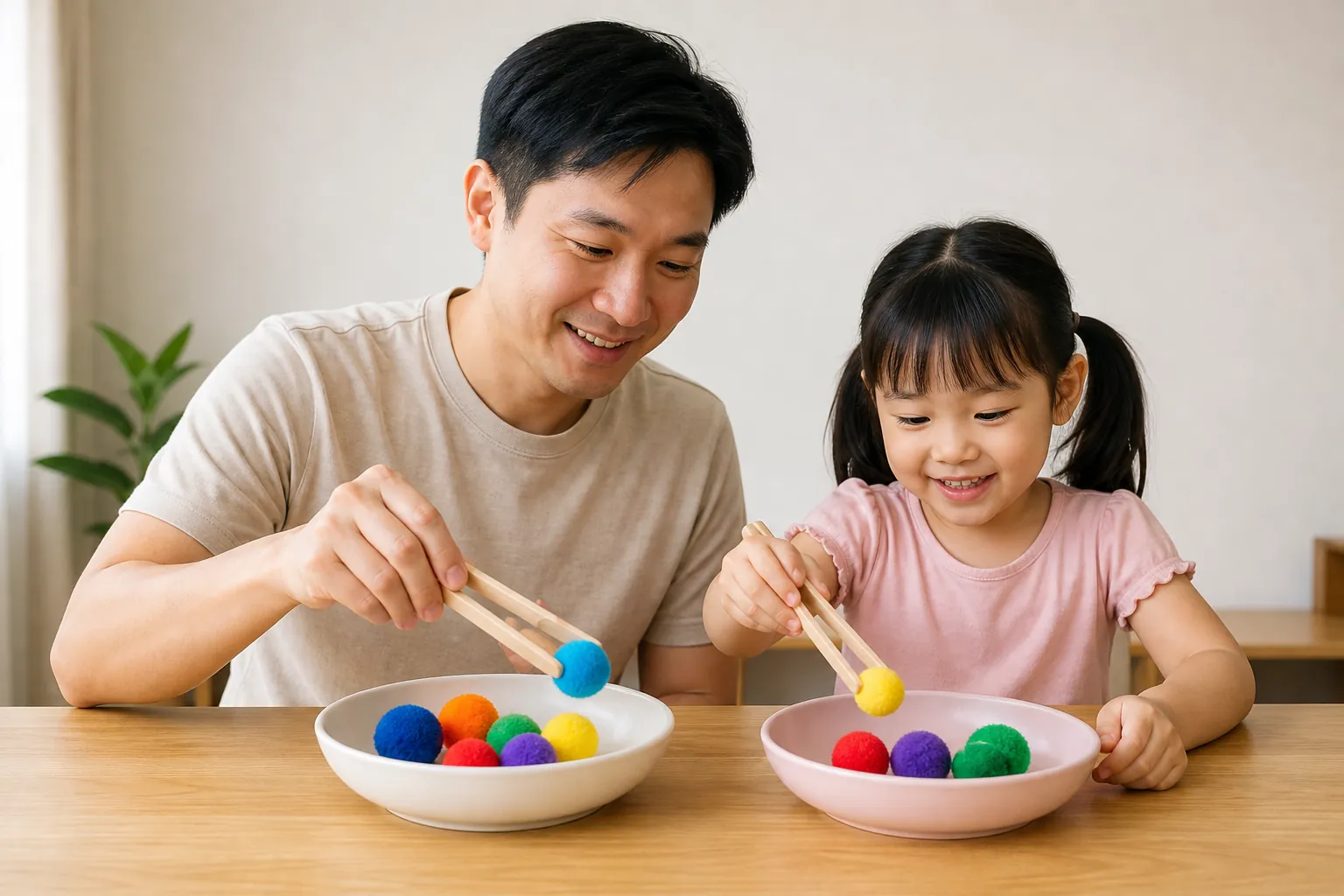
Your 5-year-old can’t cut along a line with scissors, the paper flops around because the other hand isn’t holding it steady. They can’t catch a ball because both hands don’t come together at the right time. Tying shoelaces is impossible. Buttoning a shirt takes forever. The teacher says they can’t use a ruler, one hand holds the ruler, the other draws, and somehow neither does its job properly.
This isn’t clumsiness. It’s a bilateral coordination problem, the inability to effectively use both sides of the body together. And it’s one of the most common reasons Malaysian children are referred to occupational therapy.
Bilateral coordination develops between ages 2-7 and is essential for hundreds of daily tasks. A 2016 study in the American Journal of Occupational Therapy found that 12-15% of school-age children have measurable bilateral coordination difficulties, with boys affected 2-3 times more often than girls. Without intervention, these difficulties persist, the 7-year-old who can’t cut along a line becomes the 12-year-old who can’t type, the 17-year-old who can’t drive, and the adult who avoids sports and manual tasks.
Concerned about your child’s coordination? Get an OT assessment.
What Is Bilateral Coordination?
Bilateral coordination is the ability to use both sides of the body in a controlled, organised way. There are three types:
1. Symmetrical Bilateral Coordination
Both hands do the same thing at the same time:
- Catching a ball (both hands close simultaneously)
- Pushing a rolling pin (both hands push together)
- Jumping (both feet leave the ground together)
- Clapping
- Pull-ups (both arms pull together)
2. Reciprocal Bilateral Coordination
Both sides alternate in a rhythmic pattern:
- Walking (left-right-left-right)
- Crawling
- Climbing stairs (alternating feet)
- Swimming
- Drumming with alternating hands
- Riding a bicycle (pedalling with alternating feet)
3. Asymmetrical Bilateral Coordination
Each hand does a different task simultaneously:
- Cutting with scissors (one hand cuts, the other holds and turns the paper)
- Writing (one hand writes, the other stabilises the paper)
- Opening a jar (one hand holds, the other twists)
- Playing guitar (one hand strums, the other frets)
- Using cutlery (one hand holds the fork, the other cuts)
Asymmetrical coordination is the most complex and develops last. It’s also the type most critical for school success, and the type most commonly impaired.
Signs of Bilateral Coordination Problems
At Home (Age 3-6)
- Difficulty dressing: can’t pull a shirt over the head, can’t manage buttons or zippers
- Messy eating: can’t use fork and spoon together, food falls off the plate
- Can’t open containers or packages
- Avoids construction toys (Lego, blocks) that require two-hand assembly
- Can’t hold paper while drawing, the paper slides around
- Difficulty with bathing: can’t wash one arm with the other hand
At School (Age 5-7)
- Cannot cut along a line with scissors
- Paper moves while writing, no stabilising hand
- Cannot use a ruler to draw a straight line
- Difficulty with craft activities (gluing, folding, stapling)
- Poor at ball games (catching, throwing, batting)
- Cannot tie shoelaces
- Struggles with musical instruments
Movement Signs
- Didn’t crawl (or crawled briefly) as an infant
- Awkward running pattern (arms don’t swing reciprocally)
- Difficulty climbing playground equipment
- Can’t skip (requires reciprocal leg coordination)
- Avoids riding a bicycle
- Cannot do jumping jacks (arms and legs don’t coordinate)
Why It Happens
Bilateral coordination requires the two hemispheres of the brain to communicate effectively across the corpus callosum (the bridge between left and right brain). When this communication is inefficient, the two sides of the body can’t coordinate smoothly.
Common contributing factors:
- Developmental delay: The neural pathways simply haven’t matured yet
- Missed crawling stage: Crawling is a critical bilateral reciprocal activity that builds the neural foundations for later coordination
- Sensory processing differences: Poor proprioceptive awareness (not knowing where the body is in space) affects coordination
- Neurological conditions: Cerebral palsy, autism, ADHD, all affect bilateral coordination
- Prematurity: Premature birth is associated with reduced corpus callosum development
Find a paediatric OT for coordination
How OT Assesses Bilateral Coordination
The assessment takes 45-60 minutes:
- Standardised testing: Bruininks-Oseretsky Test of Motor Proficiency (BOT-2) includes specific bilateral coordination subtests with age-based norms
- Clinical observation: The OT watches the child perform daily tasks: cutting, writing, dressing, ball handling
- Developmental history: When the child crawled, walked, and achieved other motor milestones
- Crossing midline assessment: Can the child reach across the centre of their body? Midline crossing is a prerequisite for bilateral coordination
- Hand dominance evaluation: Has the child established a dominant hand? Delayed dominance (after age 6) may indicate bilateral coordination issues
How OT Treats Bilateral Coordination
Crossing Midline Activities
Before the hands can work together, the child must be able to cross the midline (an imaginary vertical line down the centre of the body):
- Drawing large figure-eights on a whiteboard
- Reaching across the body to pick up objects placed on the opposite side
- Passing a ball around the body
- Windmill arm swings
- Cross-body tapping games (right hand taps left knee, left hand taps right shoulder)
Symmetrical Activities
Building the foundation with same-action tasks:
- Rolling playdough with both hands (rolling pin)
- Tearing paper (both hands pull apart)
- Popping bubble wrap (both hands squeeze)
- Catching large balls with both hands
- Carrying large objects with both hands
- Pulling apart construction toys
Reciprocal Activities
Building alternating coordination:
- Drumming (alternating hands on a drum or table)
- Crawling obstacle courses
- Bicycle or tricycle riding
- Swimming
- Walking on hands (wheelbarrow walks) while an adult holds feet
- Climbing ladders and climbing walls
Asymmetrical Activities (The Goal)
The functional targets:
- Cutting with scissors (graded: cutting playdough → cutting straight lines → cutting curves → cutting complex shapes)
- Lacing activities (threading beads, lacing cards)
- Stabilising paper while drawing or writing
- Opening containers (one hand holds, one hand opens)
- Using tools (hammer and nail, screwdriver and screw)
Home Programme
The OT designs daily activities parents can embed into routines:
- Cooking together: stirring with one hand while the other holds the bowl
- Craft time: cutting, gluing, folding
- Music: drumming, shaker instruments
- Active play: ball games, bicycle riding, climbing
- Self-care practice: buttoning, zipping, shoelace tying
Treatment Duration and Cost
| Service | Cost |
|---|---|
| Initial assessment (45-60 min) | RM 150 – RM 300 |
| Treatment sessions (weekly) | RM 120 – RM 200 |
| Home programme (included) | RM 0 |
Typical treatment: 10-16 weekly sessions. Most children show measurable improvement within 8 sessions. Treatment may need to continue longer for children with underlying neurological conditions.
Total cost: RM1,350-3,500 for a full course of treatment.
Frequently Asked Questions
Is bilateral coordination related to hand dominance? Yes. Bilateral coordination and hand dominance develop together. A child who hasn’t established a dominant hand by age 6 may be experiencing bilateral coordination difficulties. The OT assesses both and addresses them together.
My child skipped crawling and went straight to walking. Is that a problem? Possibly. Crawling is the primary activity that develops reciprocal bilateral coordination in infancy. Children who skip crawling may develop coordination more slowly. This doesn’t guarantee problems, many children who skip crawling develop normally, but if your child has coordination difficulties, the skipped crawling stage is relevant history for the OT.
Will sports help my child’s bilateral coordination? Some sports are excellent bilateral coordination training: swimming, martial arts, gymnastics, and cycling. However, if the underlying problem is significant, the child may become frustrated and refuse participation. OT builds the foundational skills that make sports accessible and enjoyable.
Both Hands. One Brain. The Connection Can Be Trained.
Bilateral coordination isn’t talent, it’s a neurological skill that develops with the right input. An OT provides that input through structured, progressive activities that build the brain connections needed for both hands to work as a team.
Chat with us on WhatsApp to book a motor skills assessment, anywhere in Malaysia.