
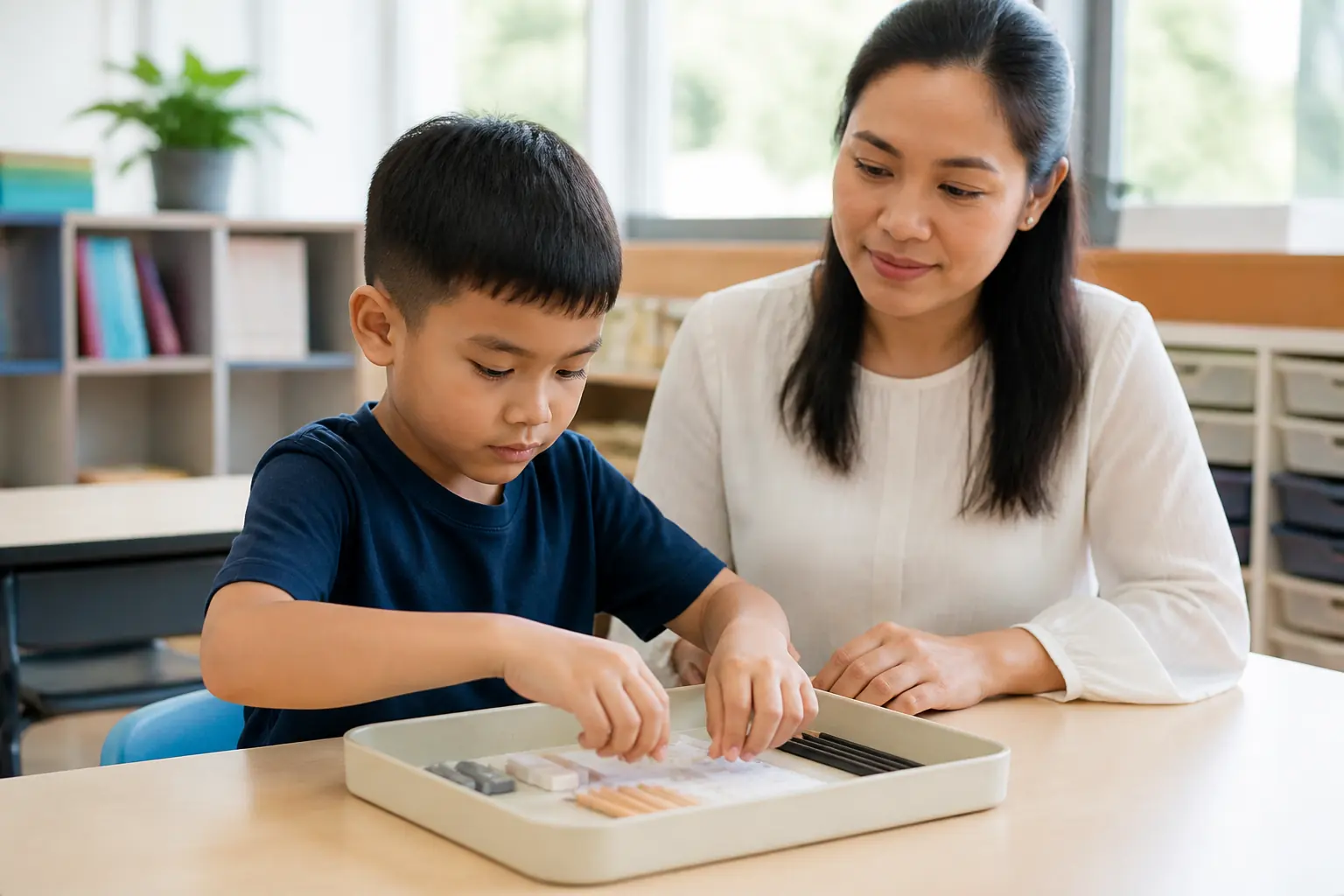
Your child starts kindergarten. The teacher sends home worksheets. Your child grips the crayon in a fist, presses too hard, and gives up after writing two letters. Other children in the class are writing their names. Yours won’t even try.
This is one of the most common concerns Malaysian parents bring to occupational therapists. And the answer depends on what exactly is happening with your child’s hands.
What’s Normal Pencil Grip Development?
Pencil grip develops in predictable stages. Here’s what the research shows:
| Age | Expected Grip | What It Looks Like |
|---|---|---|
| 1-2 years | Palmar grasp | Whole fist wrapped around crayon |
| 2-3 years | Digital pronate | Fingers point down, wrist turned |
| 3-4 years | Static tripod or quadrupod | Three or four fingers hold pencil, arm moves |
| 4-5 years | Dynamic tripod | Three fingers control pencil, fingers move |
| 5-6 years | Mature grip | Efficient, comfortable writing for age |
If your 5-year-old is still using a fist grip (palmar grasp), that’s a 3-year gap. If they’re using a static tripod but writing is slow and laboured, the grip stage is on track but the muscles may be weak.
A gap of 12 months or more warrants an OT assessment. In Malaysia, this costs RM150-RM250 at a private clinic or RM5-RM30 at a government hospital.
Why Can’t My Child Hold a Pencil Properly?
There are several possible reasons, and an OT identifies which ones apply to your child:
Weak hand muscles. The small muscles between the fingers (intrinsics) haven’t developed enough strength. This is common in children who don’t do enough hand-strengthening play, squeezing, pinching, tearing, moulding.
Poor shoulder stability. Pencil control starts at the shoulder. If your child’s shoulder muscles are weak, the arm wobbles and the hand compensates by gripping harder. Children who skip crawling or spend limited time in tummy play often have shoulder stability gaps.
Sensory avoidance. Some children dislike the feeling of a pencil in their hand. The texture, the pressure, the vibration of writing, it’s uncomfortable. These children avoid rather than struggle. This is a sensory processing issue, not a laziness issue.
Visual-motor integration difficulties. The child’s eyes and hands don’t coordinate well. They can see what to draw but can’t make their hand reproduce it. This affects copying from the board, staying within lines, and letter formation.
Limited practice. Malaysian children who spend more time on tablets and less time with crayons, playdough, and scissors may simply lack the practice hours needed for grip development. The average child needs 1,000+ hours of hand manipulation before age 5 to develop mature grip patterns.
Find a paediatric OT for handwriting support
What Will an OT Do About It?
A paediatric OT assessment for pencil grip takes 45-60 minutes. The therapist evaluates:
- Hand dominance (established by age 4-5 in most children)
- Grip pattern and stage
- Hand and finger strength
- Shoulder and arm stability
- Visual-motor integration
- Sensory preferences related to touch and pressure
Based on the results, the OT creates a targeted plan. This typically involves:
Weeks 1-4: Strengthening activities. Playdough manipulation, clothespin games, tearing paper, squeezing sponges. No pencil work yet, the foundation comes first.
Weeks 5-8: Grip training. Introduction of adapted pencils or grips. Short drawing tasks (30 seconds to 2 minutes). Vertical surface activities, drawing on an easel or wall strengthens the wrist position needed for writing.
Weeks 9-12: Letter formation. Structured handwriting programme. The OT prescribes specific letter practice sequences based on motor complexity, not alphabetical order.
Most children with isolated pencil grip delays improve within 8-12 sessions of weekly OT. Children with underlying sensory or coordination issues may need 16-20 sessions.
Can a Home-Visit OT Help with Pencil Grip?
Yes. Home-visit paediatric OT is particularly effective for pencil grip because the therapist watches your child at their actual homework desk, same chair, same table height, same lighting, same distractions, and can correct the seating and table setup while they correct the grip.
The OT leaves you a weekly activity plan and specific grip aids to trial. Home-visit sessions cost RM200-RM400. Over a 12-week programme, families in outer Klang Valley and smaller towns often save on petrol, parking, and waiting time compared to a weekly clinic drive.
What You Can Do at Home Right Now
While waiting for an OT appointment, these activities build the hand strength needed for pencil grip:
- Playdough daily, rolling, pinching, and moulding for 10 minutes builds intrinsic hand muscles
- Clothespin games, picking up small objects with clothespins strengthens the tripod fingers
- Vertical drawing, tape paper to the wall and let your child draw standing up. This positions the wrist correctly
- Tearing paper, tearing (not cutting) builds bilateral coordination and finger strength
- Water play with squeeze bottles, squeezing water from small bottles strengthens the whole hand
Do not force pencil practice. If your child’s muscles aren’t ready, forcing grip only creates frustration and avoidance.
Frequently Asked Questions
Should I buy a pencil grip aid? Grip aids can help as a temporary bridge, but they don’t fix the underlying weakness. An OT recommends the right type of grip aid, triangular, crossover, or weighted, based on your child’s specific pattern. Using the wrong grip aid can reinforce bad habits.
Will my child be ready for Standard 1 if they can’t hold a pencil at 5? Malaysian children enter Standard 1 at age 7. That leaves 2 years for intervention. Most pencil grip delays resolve within 3-6 months of weekly OT. Your child has time, but starting sooner means less pressure later.
Is pencil grip delay related to autism or ADHD? Pencil grip delays occur in neurotypical children and in children with developmental conditions. The delay itself doesn’t indicate autism or ADHD. However, if pencil grip issues appear alongside sensory sensitivities, attention difficulties, or social challenges, a broader developmental assessment may be warranted.
Don’t Wait for Standard 1
The gap between your child’s grip and their classmates’ will be visible on the first day of school. Starting OT now, at age 5, gives your child the best chance of walking into Standard 1 with a functional pencil grip and the confidence to use it.
Chat with us on WhatsApp to find a paediatric OT near you.