
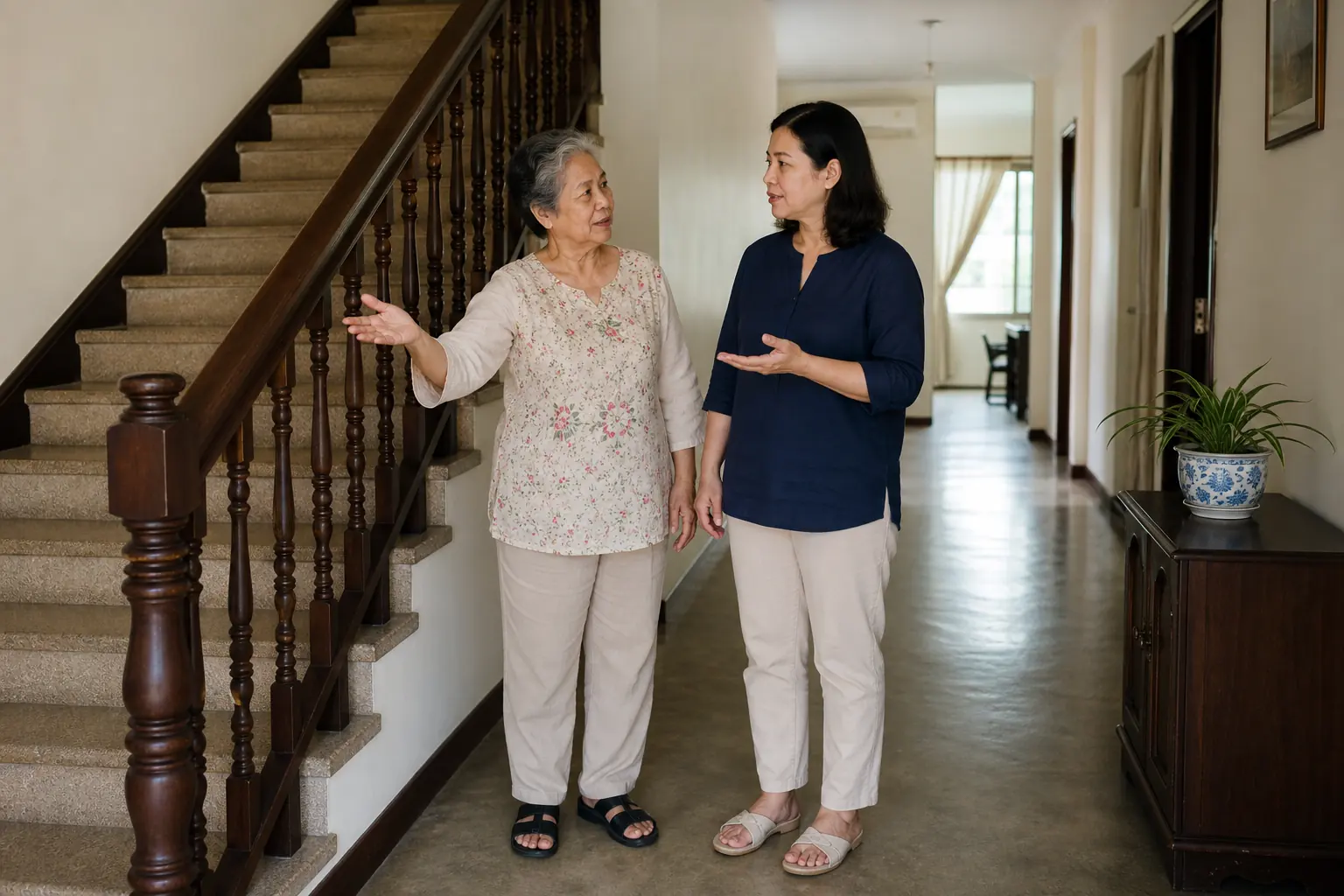
You’re in Singapore. Or Melbourne. Or London. Your mother is in Ipoh. She fell last month. Your brother says she’s fine. She says she’s fine. Nobody is fine, you can hear it in her voice, and you’ve seen the bruise in the photo she didn’t mean to send.
An estimated 1.86 million Malaysians live overseas, according to the World Bank. Many left ageing parents behind, parents who are now declining, falling, forgetting, and stubbornly insisting they don’t need help. You can’t be there in person. But you can arrange professional help that’s more effective than the daily WhatsApp check-in that’s currently your only tool.
An occupational therapist in your parent’s area provides something no amount of long-distance worry can: an objective assessment of your parent’s actual function, safety, and needs, followed by concrete changes that reduce risk.
Worried about your parent back home? An OT can help.
What You Can Arrange from Overseas
1. Home Safety Assessment
The OT visits your parent’s home and evaluates fall risks, safety hazards, and accessibility barriers. This is the single most valuable service for overseas children of ageing parents.
The assessment covers every room: bathroom (wet floor risk, grab bars, toilet height), bedroom (bed height, night-time path to bathroom), kitchen (stove safety, reaching hazards), and all walking routes (rugs, lighting, stairs).
After the assessment, the OT sends you a detailed report with:
- Prioritised list of modifications (what to fix first)
- Specific product recommendations (exact items, where to buy in Malaysia)
- Cost estimates for each modification
- Photos of problem areas
You can arrange the modifications from overseas, ordering items online, hiring a local handyman, or asking a family member to install them. Total cost for assessment + basic modifications: RM400-RM1,200.
2. Functional Capacity Assessment
Is your parent really “fine”? The OT objectively measures:
- Can they shower safely? (Timed, observed, with fall risk scoring)
- Can they prepare a simple meal? (Cognitive sequencing, physical safety)
- Can they manage medications? (Correct dose, correct time, no missed or doubled doses)
- Can they get to appointments? (Driving assessment or public transport competency)
- Can they handle an emergency? (Using a phone, unlocking the door, getting to safety)
The honest answers to these questions determine what level of support your parent actually needs, from “independent with minor modifications” to “needs daily assistance” to “unsafe to live alone.”
This assessment prevents two common mistakes: doing too little (leaving a declining parent at risk) and doing too much (forcing a competent parent into unwanted dependence).
3. Domestic Helper Training
If your parent has a live-in helper (common in Malaysian households), the OT trains the helper on:
- Safe transfer techniques (bed to chair, chair to toilet)
- Fall prevention strategies
- Medication management routines
- Meal preparation for specific dietary needs
- Emergency response protocols
- When to call the family or doctor
An untrained helper can inadvertently increase fall risk (pulling a person to stand instead of guiding them), cause pressure sores (incorrect positioning), or enable dependence (doing everything for the person instead of prompting them to participate).
Training takes 1-2 sessions and costs RM240-RM400.
Find a geriatric OT in your parent’s area
4. Family Debrief by Phone or WhatsApp
The OT calls you (wherever you are) to:
- Explain the assessment findings in detail
- Answer your questions about your parent’s capabilities
- Recommend the level of care needed (independent, assisted, supervised, full care)
- Discuss residential care options if appropriate
- Help you plan the next family visit with specific goals
5. Ongoing Monitoring
For parents who are gradually declining, the OT provides quarterly home visits that track changes over time:
- Is function declining faster than expected?
- Are the modifications still adequate?
- Has a new risk emerged (new medication, new symptoms, social withdrawal)?
- Does the care level need adjustment?
Each quarterly visit costs RM200-RM400 and includes an updated report sent to you.
Cost Summary
| Service | Cost | How to Pay from Overseas |
|---|---|---|
| Home safety assessment | RM 200 – RM 400 | Bank transfer, online payment |
| Functional capacity assessment | RM 200 – RM 400 | Bank transfer, online payment |
| Helper training (1-2 sessions) | RM 240 – RM 400 | Bank transfer, online payment |
| Phone/WhatsApp family debrief (30 min) | RM 100 – RM 200 | Online payment |
| Quarterly monitoring visit | RM 200 – RM 400 | Standing arrangement |
| Equipment and modifications | RM 200 – RM 1,500 | Order online, deliver to parent’s home |
Total annual cost for quarterly monitoring + initial assessment: RM1,000-RM2,000.
How to Get Started from Overseas
- Contact us on WhatsApp with your parent’s location (city and state)
- We match you with an OT in your parent’s area
- You authorise the assessment (your parent’s consent is also needed)
- The OT visits your parent and conducts the assessment
- You receive the report via email with a WhatsApp or phone debrief
- Together, you implement the recommendations
The entire process, from first contact to completed assessment, takes 1-2 weeks.
Frequently Asked Questions
My parent refuses help. What do I do? Resistance is normal. The OT approaches the visit as a “home check” rather than an assessment of the parent. Framing matters: “I arranged someone to check the house is set up well for you” is less threatening than “I’m worried you can’t cope.” Most parents accept once they meet the therapist.
Can the OT force my parent to accept modifications? No. The OT recommends and persuades, but cannot force changes. If your parent refuses critical modifications (like grab bars), the OT documents this in the report. You then have the information to make informed decisions about the level of risk you’re comfortable with.
What if my parent needs full-time care? The OT can recommend care options: live-in domestic help, day care centres, or residential care facilities in your parent’s area. They can also assess whether your parent’s home can be adapted for higher-level care or whether a move is more practical.
You Can’t Be There. An OT Can.
The gap between your parent saying “I’m fine” and reality is filled by professional assessment. One visit gives you more actionable information than months of worried phone calls.
Chat with us on WhatsApp to arrange a home assessment for your parent, anywhere in Malaysia.