
You bought a wheelchair from Shopee. It doesn’t fit. The seat is too wide, the wheels are too small for your house, and your shoulders ache after 20 minutes. You spent RM800 on a device that’s now collecting dust in the corner.
This happens constantly in Malaysia. Families buy assistive devices without professional guidance, wheelchairs, walking aids, communication devices, adaptive equipment, and end up with products that don’t match their needs. An occupational therapist prevents this by assessing what you actually need, recommending specific products, and training you to use them.
The World Health Organization estimates that only 10% of people who need assistive technology worldwide have access to it. In Malaysia, the number is higher thanks to government subsidy programmes, but access doesn’t equal appropriateness. Having a wheelchair isn’t the same as having the right wheelchair.
Need assistive technology? An OT matches the right device to you.
What Counts as Assistive Technology
Assistive technology (AT) is any device, equipment, or system that helps a person perform tasks they otherwise couldn’t, or couldn’t do safely. It ranges from simple to complex:
Low-Tech AT (Under RM100)
| Device | Who It Helps | Cost |
|---|---|---|
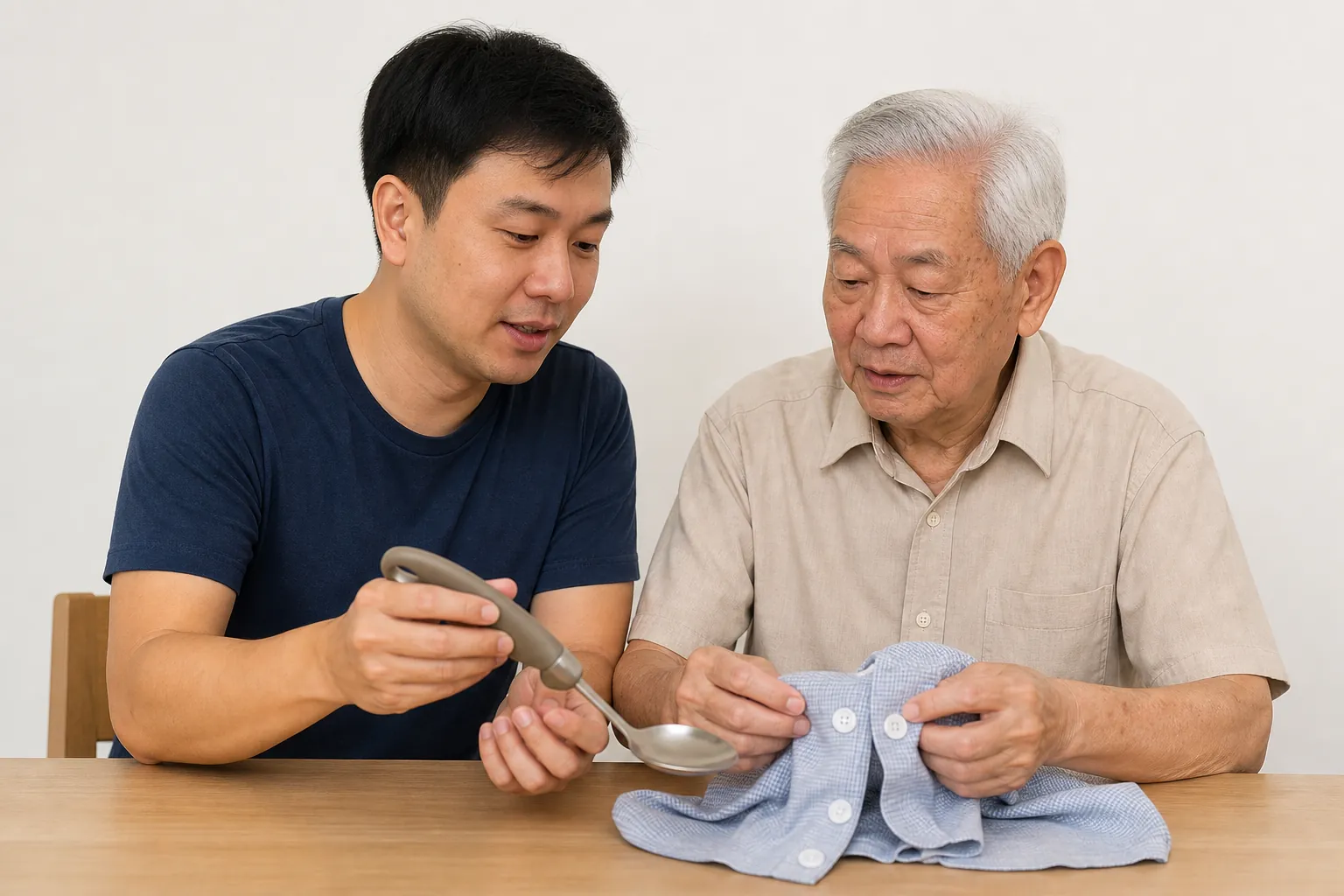
| Built-up handle spoon | Weak grip (stroke, arthritis, CP) | RM 20 – RM 50 |
| Button hook | One-handed dressing | RM 15 – RM 30 |
| Non-slip mat | Prevents plates sliding during one-handed eating | RM 10 – RM 25 |
| Reacher/grabber | Limited bending or reaching | RM 20 – RM 40 |
| Pencil grip | Fine motor difficulties in children | RM 5 – RM 15 |
| Picture communication board | Non-verbal communication | RM 0 – RM 30 (printable) |
Mid-Tech AT (RM100-RM5,000)
| Device | Who It Helps | Cost |
|---|---|---|
| Weighted cutlery | Tremor (Parkinson’s, essential tremor) | RM 100 – RM 300 |
| Bath lift | Can’t get in/out of bathtub safely | RM 500 – RM 2,000 |
| Electric page turner | Limited hand function for reading | RM 200 – RM 500 |
| Adapted keyboard | Physical limitations affecting typing | RM 200 – RM 800 |
| Communication app on tablet | Speech difficulties (autism, stroke, CP) | RM 100 – RM 500 (app cost) |
High-Tech AT (RM5,000+)
| Device | Who It Helps | Cost |
|---|---|---|
| Powered wheelchair | Inability to self-propel manual chair | RM 5,000 – RM 40,000 |
| Eye-gaze communication system | Severe physical disability with preserved cognition | RM 15,000 – RM 50,000 |
| Environmental control unit | Quadriplegia, controls lights, doors, TV by voice/switch | RM 2,000 – RM 10,000 |
| Stairlift | Mobility impairment in multi-level home | RM 15,000 – RM 40,000 |
| Vehicle hand controls | Lower limb paralysis, enables driving | RM 3,000 – RM 10,000 |
Why You Need an OT Before Buying
An OT assessment prevents three expensive mistakes:
Mistake 1: Wrong Device
A standard wheelchair from a medical supply shop is designed for temporary hospital use, not for daily independent mobility. An active wheelchair user needs a lightweight, custom-fitted chair with proper wheel position, seat width, and back support. The RM800 hospital wheelchair and the RM8,000 active wheelchair serve completely different purposes.
Mistake 2: Wrong Setup
A communication tablet is useless if the child can’t access it. Does the child need a touch screen, a switch, an eye-gaze system, or a head pointer? The OT assesses the child’s motor abilities and selects the access method before choosing the device. Buying the tablet first is putting the technology before the user.
Mistake 3: Abandoned Device
Research consistently shows that 30-50% of assistive technology is abandoned within the first year. The primary reason: the device doesn’t fit the person’s daily routine, environment, or abilities. An OT assessment reduces abandonment rates by matching the device to the user’s actual life, not to a product catalogue.
Find an assistive technology OT
The AT Assessment Process
Step 1: Needs Assessment (60-90 min)
The OT evaluates:
- What tasks you can’t do (or can’t do safely) right now
- What physical, cognitive, and sensory abilities you have
- Your home, school, or workplace environment
- Your goals (what do you want to be able to do?)
- Your budget and funding options
Step 2: Device Trial
The OT arranges trials of recommended devices. For wheelchairs, this means sitting in different models. For communication devices, this means testing different access methods. Trials prevent buyer’s regret.
Step 3: Prescription and Procurement
The OT writes a prescription specifying:
- Exact device make and model
- Custom modifications needed (seat width, control type, mounting position)
- Training requirements
- Justification for funding applications
Step 4: Setup and Training
Once the device arrives, the OT:
- Fits and adjusts it to the user
- Trains the user (and caregivers) in operation
- Integrates it into daily routines
- Schedules follow-up to check for problems
Funding AT in Malaysia
| Source | What It Covers | How to Access |
|---|---|---|
| JKM (OKU card holders) | Equipment subsidies up to RM5,000 | Apply at district JKM office with OT prescription |
| SOCSO | Full AT coverage for work-related disabilities | Through SOCSO rehabilitation department |
| Private insurance | Varies, check “medical equipment” benefit | Doctor’s prescription + OT recommendation |
| Tax relief | RM6,000 deduction for supporting equipment | Keep receipts, claim under disabled dependant relief |
| NGOs | Specific device donations (wheelchairs, hearing aids) | Apply directly to relevant NGO |
JKM is the primary government funder for assistive technology. The OT’s prescription report strengthens your application significantly, JKM assessors rely on professional recommendations to approve funding.
Cost of AT Assessment
| Service | Cost |
|---|---|
| AT needs assessment (60-90 min) | RM 200 – RM 400 |
| Device trial session | RM 120 – RM 200 |
| Equipment setup and training | RM 120 – RM 200 |
| Follow-up and adjustment | RM 120 – RM 200 |
| Written prescription report | Usually included in assessment |
Total OT cost for a full AT assessment and setup: RM400-RM800. This investment prevents thousands of ringgit in wrong purchases.
Frequently Asked Questions
Can I buy AT online without an OT assessment? You can, but the risk of buying the wrong device is high. Low-tech items (grabbers, built-up handles) are safe to buy independently. Mid-tech and high-tech items should always be assessed, the consequences of a wrong purchase are expensive and functionally limiting.
Does my child need AT for school? Many children with disabilities benefit from AT in school: adapted scissors, pencil grips, slant boards, tablets for writing, communication apps. The OT specifies which devices are needed and writes a letter for the school’s Inclusive Education Programme.
How often does AT need to be replaced? Low-tech items: 1-3 years. Manual wheelchairs: 3-5 years. Powered wheelchairs: 5-7 years. Communication devices: when software becomes outdated or the user’s needs change. Growing children need more frequent equipment updates. The OT schedules regular reviews.
The Right Technology Changes Lives. The Wrong One Collects Dust.
Assistive technology is only as good as the match between device and user. An OT makes that match precise, saving money, preventing frustration, and unlocking function that makes daily life possible.
Chat with us on WhatsApp to find an assistive technology OT near you, anywhere in Malaysia.