
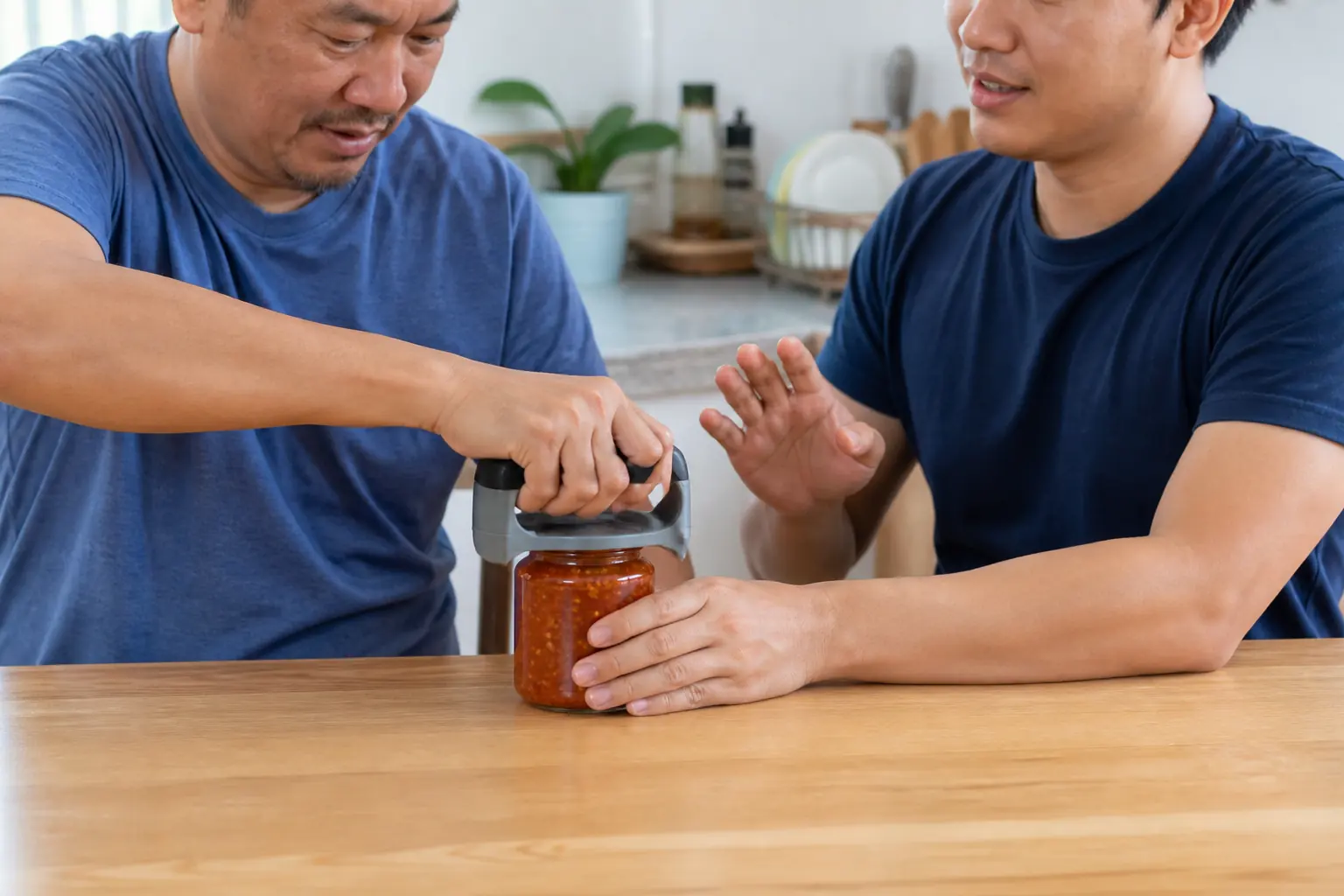
Your fingers are stiff every morning. The swelling takes an hour to go down. You can’t unscrew a bottle cap anymore. Your grip is weaker than it was last year. Chopping vegetables hurts. Writing hurts. Wringing a towel is impossible.
Rheumatoid arthritis (RA) is an autoimmune disease that attacks your joint linings. The hands are the primary target, 90% of RA patients develop hand symptoms, according to the Arthritis Foundation. In Malaysia, RA affects approximately 0.5-1% of the population (Malaysian Society of Rheumatology). That’s 160,000-320,000 Malaysians, and the hands are the battlefield.
Your rheumatologist manages the disease with DMARDs and biologics. But medication controls inflammation, it doesn’t teach you how to open a jar without destroying your knuckle joints. That’s what an OT does. And starting early, before deformity sets in, makes the difference between hands that function for decades and hands that don’t.
RA in your hands? OT protects what you have left.
What RA Does to Your Hands
RA attacks the synovial lining of joints. In the hands, this causes:
Stage 1, Inflammation: Swelling, heat, pain, and morning stiffness in finger and wrist joints. Grip strength decreases. Activities requiring finger force become painful.
Stage 2, Joint loosening: The inflamed synovium stretches ligaments and tendons. Joints become unstable. Fingers may begin to drift sideways (ulnar deviation) or develop swan-neck or boutonnière deformities.
Stage 3, Structural damage: Cartilage and bone erode. Deformities become fixed. Function is permanently reduced.
The critical window for OT is stages 1 and 2. In stage 1, joint protection and splinting prevent ligament stretching. In stage 2, splinting slows deformity progression and activity adaptation maintains function. By stage 3, options are limited to adaptive equipment and surgical referral.
What OT Does for RA Hands
1. Joint Protection Principles
The OT teaches you 8 joint protection principles that apply to every daily activity:
Respect pain. Pain is your joint telling you to stop. Activities that cause pain during or after should be modified or avoided. “Pushing through” accelerates joint destruction.
Reduce force. Every task has a low-force alternative:
| High Force | Low Force Alternative |
|---|---|
| Wringing a towel by twisting | Press towel against sink, roll to squeeze |
| Gripping a jar lid | Use a rubber jar opener or under-counter jar opener |
| Carrying bags with curled fingers | Carry with forearm, use trolley bags |
| Turning a key with pinch grip | Key turner lever (RM15-30) |
| Lifting heavy pots | Use two hands, slide pots instead of lifting |
Distribute load. Use the largest, strongest joint possible. Carry shopping bags on the forearm, not with fingertips. Use both hands instead of one.
Avoid sustained grip. Holding any object tightly for more than a few minutes loads the joints. Use book holders, phone stands, and jar clamps instead of sustained hand holding.
Avoid positions of deformity. Certain hand positions accelerate ulnar drift:
- Wringing motions (twisting towards the small finger)
- Side-to-side pressure on finger joints
- Gripping with fingers curled and wrist flexed
The OT identifies which daily activities are putting your joints in deforming positions and provides alternatives.
2. Splinting
Splints support unstable joints and prevent deformity progression:
Resting splints (night): Hold the wrist and fingers in a neutral position overnight, reducing morning stiffness and preventing deformity during sleep. Custom-made by the OT from thermoplastic material. Cost: RM100-300 per splint.
Working splints (day): Support the wrist during activities while allowing finger movement. Wrist cock-up splints are the most common, they take load off the wrist joint during gripping tasks. Cost: RM80-250.
Ring splints: Small silver or thermoplastic rings that prevent hyperextension of finger joints (swan-neck deformity). Cost: RM30-100 per ring.
Thumb splints: Support the CMC joint (base of thumb), which is commonly affected in RA. Allow pinch activities with less pain. Cost: RM50-200.
The OT custom-moulds each splint to your hand. Off-the-shelf splints from pharmacies rarely fit correctly and can cause pressure sores on swollen joints.
3. Assistive Devices
The OT prescribes specific devices for tasks you’re struggling with:
| Task Problem | Device | Cost |
|---|---|---|
| Can’t grip cutlery | Built-up handle cutlery | RM 30 – RM 80 |
| Can’t turn taps | Lever tap turners | RM 20 – RM 50 |
| Can’t open jars | Electric jar opener | RM 50 – RM 150 |
| Can’t button shirts | Button hook | RM 15 – RM 30 |
| Can’t grip pen | Ergonomic grip pen | RM 10 – RM 30 |
| Can’t turn keys | Key turner handle | RM 15 – RM 30 |
| Can’t open cans | Electric can opener | RM 50 – RM 100 |
| Can’t wring towel | Towel wringer device | RM 30 – RM 80 |
Many of these are available from medical supply stores in Malaysia or ordered online from Shopee and Lazada. The OT tells you exactly which product to buy, not just “get a jar opener” but the specific type that works for your hand and your jars.
4. Exercise Programme
RA hand exercises walk a fine line between maintaining movement and overloading inflamed joints:
During flare (active inflammation):
- Gentle range-of-motion exercises only
- No resistance exercises
- Move each joint through its full available range once daily
- Stop at the first sign of pain
Between flares:
- Range-of-motion exercises twice daily
- Gentle strengthening with theraputty or foam squeeze (lowest resistance)
- Functional exercises: picking up coins, turning pages, using cutlery
- Never exercise to the point of pain or fatigue that lasts more than 2 hours after
Hot paraffin wax treatment: Before exercise, dipping hands in warm paraffin wax (RM200-400 for a home unit) reduces stiffness and pain, making exercise more comfortable and effective. The OT demonstrates the technique and temperature.
5. Energy Conservation
RA produces systemic fatigue, not just hand fatigue. The OT teaches pacing for the entire day:
- Alternate heavy and light tasks
- Sit for tasks usually done standing (food prep, ironing)
- Use powered tools instead of manual (electric chopper, food processor, electric can opener)
- Batch tasks: prepare multiple meals at once when energy is available
Cost of OT for RA Hands
| Service | Cost |
|---|---|
| Initial hand assessment | RM 150 – RM 300 |
| Custom splint fabrication (each) | RM 80 – RM 300 |
| Treatment sessions (weekly/biweekly) | RM 120 – RM 200 |
| Home programme + equipment prescription | Included |
Typical treatment: 6-8 sessions over 3 months, then reassessment every 6 months or when disease activity changes. Total initial cost: RM1,000-2,500 including splints.
Frequently Asked Questions
At what stage of RA should I start OT? Immediately after diagnosis, even if hand symptoms are mild. Joint protection habits learned early prevent damage that’s irreversible later. The rheumatologist manages the disease; the OT manages the function. Both should start simultaneously.
Will the splints cure my RA? No. Splints don’t treat the disease, they protect your joints from further damage while the medication controls the disease. Think of splints as seatbelts: they don’t prevent accidents, but they reduce the injury when stress occurs.
I’ve already developed deformities. Is OT still useful? Yes. Even with established deformities, OT helps with adaptive equipment, splinting to prevent further deformity, exercise to maintain remaining range, and task modification. Function can often be improved significantly even when anatomy has changed.
Your Joints Are Being Attacked. OT Teaches Them to Defend.
RA medication fights the disease from inside. OT protects your joints from outside, every time you open a jar, carry a bag, or grip a handle. Together, they keep your hands working for years longer than either alone.
Chat with us on WhatsApp to find a hand therapy OT, anywhere in Malaysia.