
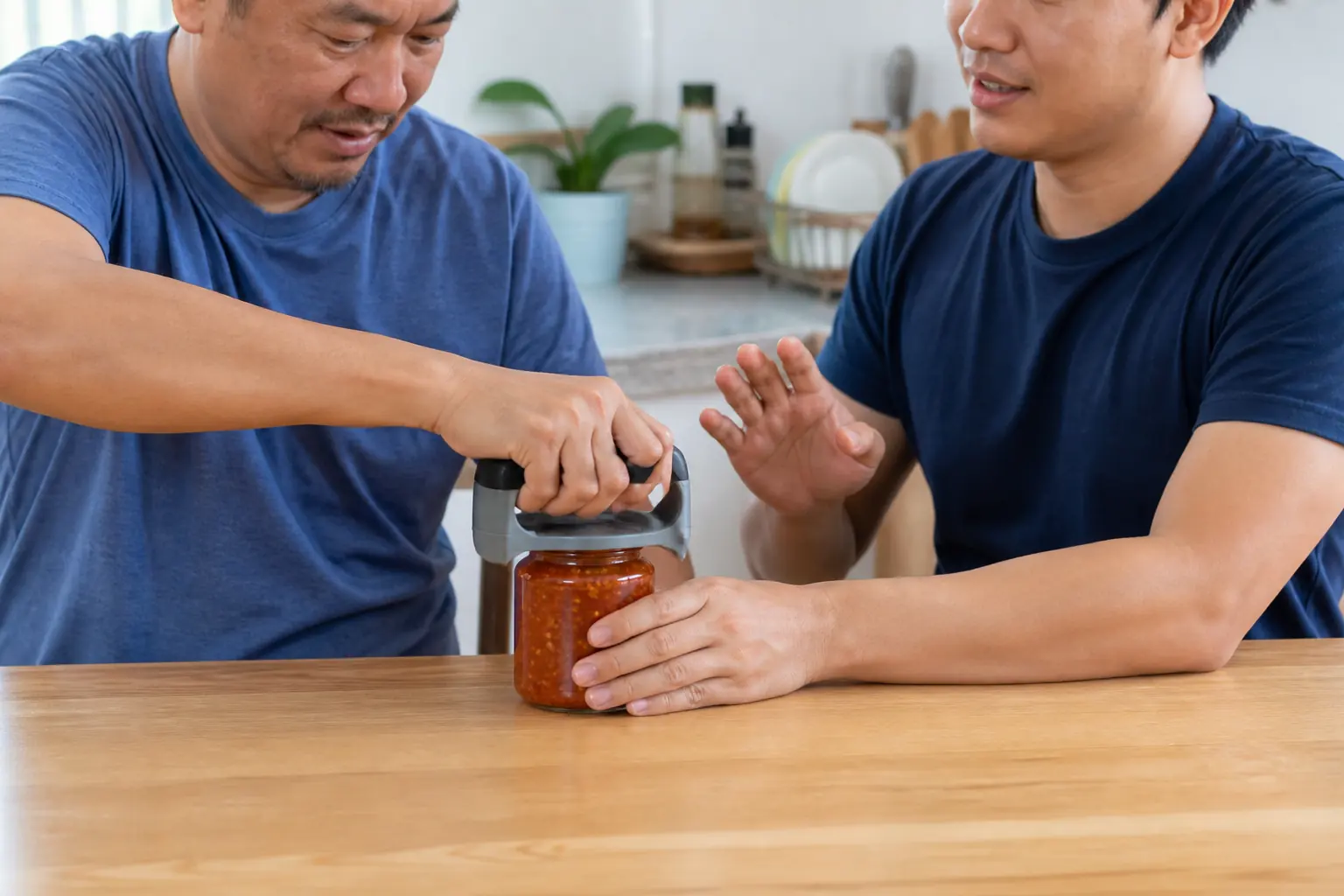
You’ve had psoriasis for years, the skin patches are manageable. Then your fingers started swelling. Not the knuckles like rheumatoid arthritis. The entire finger, swollen like a sausage. Your nails are pitted and crumbling. The DIP joints (the joints closest to your fingertips) ache and stiffen. Gripping a bottle cap sends pain shooting through your hand.
Psoriatic arthritis (PsA) affects 20-30% of people with psoriasis (Annals of the Rheumatic Diseases, 2020). In Malaysia, with an estimated psoriasis prevalence of 2-3% (Malaysian Dermatological Society), that’s roughly 130,000-200,000 people living with psoriatic arthritis. The hands are involved in over 50% of PsA cases, and unlike rheumatoid arthritis, PsA frequently attacks the DIP joints, the ones you need most for fine motor tasks like buttoning shirts, typing, and holding chopsticks.
The rheumatologist manages the disease with medication. The OT manages what the disease does to your daily life.
Psoriatic arthritis in your hands? OT protects function.
How PsA Differs from Rheumatoid Arthritis in the Hands
This distinction matters because the OT approach differs:
| Feature | Psoriatic Arthritis | Rheumatoid Arthritis |
|---|---|---|
| Joints affected | DIP (fingertips), asymmetric | MCP/PIP (knuckles), symmetric |
| Pattern | Entire finger swells (“dactylitis”) | Joint-specific swelling |
| Nails | Pitting, crumbling, lifting | Usually unaffected |
| Tendon involvement | Enthesitis (tendon attachment inflammation) | Tendon sheath synovitis |
| Deformity pattern | Telescoping, pencil-in-cup | Ulnar drift, swan neck |
| Stiffness timing | Morning + after rest | Primarily morning |
PsA’s tendency to attack tendons and entheses (where tendons attach to bone) means that grip strength loss and tendon pain are often more prominent than pure joint swelling.
What PsA Does to Hand Function
Dactylitis (sausage fingers): The entire finger swells, making rings impossible to wear, gloves impossible to fit, and fine motor tasks difficult. The swelling is painful and restricts bending.
DIP joint destruction: The small joints at your fingertips stiffen and deform. Activities requiring fingertip precision, picking up coins, fastening buttons, using a touchscreen, become increasingly difficult.
Enthesitis: Inflammation where tendons attach to bone causes pain during gripping, pinching, and pulling. Opening jars, turning keys, and squeezing are painful.
Nail involvement: Pitted, crumbling nails make fine pinch grip weaker and nail care difficult.
Functional decline timeline: Without intervention, studies show a 40% decline in hand function over 5 years in PsA patients with hand involvement (Arthritis Care & Research, 2019).
OT Management for PsA Hands
1. Joint Protection Principles
The OT teaches you to use your hands in ways that minimise joint stress:
The big rules:
- Distribute load across large joints: Carry bags on the forearm, not by finger grip
- Use the strongest joint available: Push doors open with your palm or shoulder, not your fingers
- Avoid sustained grip: Use timers, release grip every 5-10 minutes during sustained tasks
- Avoid twisting motions: Use lever taps, electric jar openers, key turners
- Respect pain: Pain during activity means the joint is being stressed beyond safe limits, stop and modify
Practical translations:
| Task | Joint-Stressing Way | Joint-Protecting Way |
|---|---|---|
| Opening jars | Gripping lid with fingertips and twisting | Rubber grip pad + palm grip, or electric opener |
| Carrying shopping bags | Fingers through bag handles | Forearm through handles, or trolley |
| Writing | Tight pen grip | Fat-grip pen or ergonomic pen |
| Typing | Finger striking on flat keyboard | Ergonomic keyboard with light key action |
| Cooking (stirring) | Gripping thin handle | Thickened handle or electric stirrer |
| Turning keys | Pinch grip and twist | Key turner device (lever extension) |
2. Splinting
Resting splints: Custom thermoplastic splints that hold inflamed joints in a neutral, protected position. Worn during flares and at night to reduce inflammation and prevent deformity.
Ring splints (silver or thermoplastic): Small splints worn on individual fingers to stabilise unstable DIP or PIP joints. They allow function while preventing lateral deviation or hyperextension. Cost: RM50-200 per finger.
Working splints: Lightweight supports worn during activities that stress the hands (cooking, gardening, typing). They reduce joint strain while allowing functional movement.
3. Exercise Programme
PsA hands need movement to maintain range and strength, but the wrong exercise during a flare worsens inflammation.
During flare (active inflammation, swelling, heat):
- Gentle active range of motion only (move each joint through its available range, no resistance)
- Warm water soaking (37-38°C, 10 minutes) before exercise
- No resistance exercises, no gripping activities
- Duration: 5 minutes, 2-3 times daily
Between flares (stable, minimal swelling):
- Full range of motion exercises (10 repetitions each joint)
- Gentle resistance: therapeutic putty exercises (grip, pinch, roll, spread)
- Tendon gliding exercises (5 positions, 10 repetitions)
- Grip strengthening with soft resistance (start with lightest putty grade)
- Duration: 10-15 minutes daily
Critical rule: Never exercise a hot, swollen joint against resistance. Range of motion only during flares.
4. Adaptive Equipment
The OT prescribes specific devices to maintain independence:
Kitchen:
- Electric can opener: RM50-100
- Jar opener (mounted under cabinet): RM30-60
- Thick-handle cutlery: RM40-80 per set
- Lightweight pots with bilateral handles: RM60-150
Personal care:
- Button hook: RM20-40
- Zip pull: RM15-30
- Long-handled shoe horn: RM20-40
- Electric toothbrush (eliminates grip-intensive brushing): RM80-200
Work:
- Ergonomic pen with built-up grip: RM15-40
- Voice-to-text software (reduces typing): Free-RM50
- Ergonomic mouse (reduces finger clicking strain): RM100-300
5. Flare Management Plan
The OT creates a written flare action plan:
When flare starts (joints hot, swollen, painful):
- Apply resting splints to affected fingers
- Reduce hand use, delegate tasks where possible
- Range of motion exercises only (no resistance)
- Cold application to hot joints (10 minutes, 3 times daily)
- Contact rheumatologist if flare persists beyond 48 hours
When flare subsides:
- Resume strengthening exercises gradually
- Switch from resting splints to working splints
- Gradually increase activity levels
- Resume adaptive equipment use for stressful tasks
Cost
| Service | Cost |
|---|---|
| Hand function assessment (60 min) | RM 150 – RM 300 |
| Custom resting splint | RM 80 – RM 200 |
| Ring splints (per finger) | RM 50 – RM 200 |
| Treatment sessions (weekly then biweekly) | RM 120 – RM 200 |
| Adaptive equipment (basic set) | RM 100 – RM 400 |
Most sessions are covered by insurance when referred by a rheumatologist or orthopaedic surgeon.
Frequently Asked Questions
Will OT cure my psoriatic arthritis? No, PsA is an autoimmune condition managed by medication (methotrexate, biologics). OT manages the functional consequences: protecting joints, maintaining range of motion, and keeping your hands working despite the disease.
My rheumatologist hasn’t mentioned OT. Should I ask? Yes. Many rheumatologists focus on medication management and don’t routinely refer to OT. A 2021 survey found that only 30% of PsA patients with hand involvement had received OT. Request a referral, the evidence supports early OT intervention for hand preservation.
I have both psoriatic arthritis and carpal tunnel syndrome. Are they related? PsA-related tendon inflammation can cause secondary carpal tunnel syndrome. The OT assesses both conditions and manages them together, wrist splinting for carpal tunnel plus hand joint protection for PsA.
The Medication Fights the Disease. OT Fights the Disability.
Your rheumatologist controls the inflammation. Your OT controls the function. Both are needed, because a well-medicated hand that can’t open a jar is still a hand that can’t open a jar.
Chat with us on WhatsApp to find a hand therapy OT, anywhere in Malaysia.