
You tore your ACL playing futsal. The surgery went well, the orthopaedic surgeon says the graft is solid. Physiotherapy starts for the knee: range of motion, strength, balance. But nobody is answering the question that matters most to you right now: when can you go back to work?
Your surgeon says “6 months.” Your physiotherapist says “depends on the knee.” Your HR department wants a specific date. Your boss is asking daily. SOCSO needs a timeline. And you need to know whether you’ll be able to do your actual job tasks, not just walk on a treadmill.
This is where OT enters. The physiotherapist rehabilitates the knee. The OT rehabilitates the worker, assessing your specific job demands, modifying your workstation or tasks, and planning a graded return-to-work programme that matches your recovery to your job requirements.
ACL tears are the most common serious knee injury in Malaysia, particularly among young working adults who play sports (futsal, badminton, football). An estimated 5,000-8,000 ACL reconstructions are performed annually in Malaysia (Malaysian Orthopaedic Association estimates). Most of these patients are employed and need to return to work.
ACL surgery recovery? OT gets you back to work safely.
Return-to-Work Timelines by Job Type
Not all jobs are equal after ACL reconstruction. The timeline depends entirely on what your job demands:
| Job Type | Physical Demands | Typical RTW Timeline | OT Role |
|---|---|---|---|
| Office/desk work | Sitting, typing, walking to meetings | 4-6 weeks | Workstation setup, seated positioning |
| Retail/customer service | Standing, walking, light carrying | 8-12 weeks | Graduated standing tolerance, footwear |
| Teaching | Standing, walking, stair climbing | 8-12 weeks | Classroom navigation, modified duties |
| Warehouse/logistics | Lifting, carrying, climbing, squatting | 16-24 weeks | Job simulation, graded lifting programme |
| Construction/manual labour | Heavy lifting, climbing, kneeling, uneven terrain | 24-36 weeks | Full functional capacity evaluation |
| Driving (professional) | Prolonged sitting, clutch/brake operation | 8-16 weeks | Vehicle modification assessment, driving simulation |
The critical point: These timelines assume proper rehabilitation. Without structured return-to-work planning, many workers either return too early (risking re-injury or graft failure) or too late (unnecessary income loss and deconditioning).
What OT Does for ACL Return-to-Work
Phase 1: Job Demands Analysis (Week 2-4 Post-Surgery)
The OT analyses your specific job before you return:
What’s assessed:
- Physical demands: lifting, carrying, pushing, pulling, climbing, kneeling, squatting
- Positional demands: standing duration, sitting duration, walking distances
- Environmental demands: stairs, uneven surfaces, confined spaces, vehicle access
- Cognitive demands: concentration, decision-making under physical stress
- Schedule demands: shift length, break frequency, overtime requirements
Why this matters: A “warehouse worker” might spend 80% of the day on a forklift (mostly sitting, earlier return possible) or 80% of the day loading pallets by hand (heavy lifting, much later return needed). The job title doesn’t tell the whole story.
Phase 2: Graduated Return-to-Work Programme (Week 6-24)
The OT creates a staged return plan:
Stage 1, Modified duties (partial return):
- Reduced hours (4-6 hours instead of full shift)
- Light duties only (no lifting above 5kg, no stairs, no kneeling)
- Seated work where possible
- Duration: 2-4 weeks
Stage 2, Progressed duties:
- Increased hours (6-8 hours)
- Moderate lifting (up to 10-15kg)
- Walking and standing within tolerance
- Stairs with handrail
- Duration: 2-4 weeks
Stage 3, Full duties with precautions:
- Full hours
- Full lifting capacity (progressively loaded)
- All job tasks resumed
- Knee brace for high-risk activities (first 3 months)
- Duration: 2-4 weeks until fully independent
Stage 4, Full unrestricted return:
- All duties without modification
- Return to sport clearance (separate from work clearance, typically later)
Get a return-to-work assessment
Phase 3: Workplace Modification
The OT visits your workplace (or assesses via video) and recommends modifications:
Office workers:
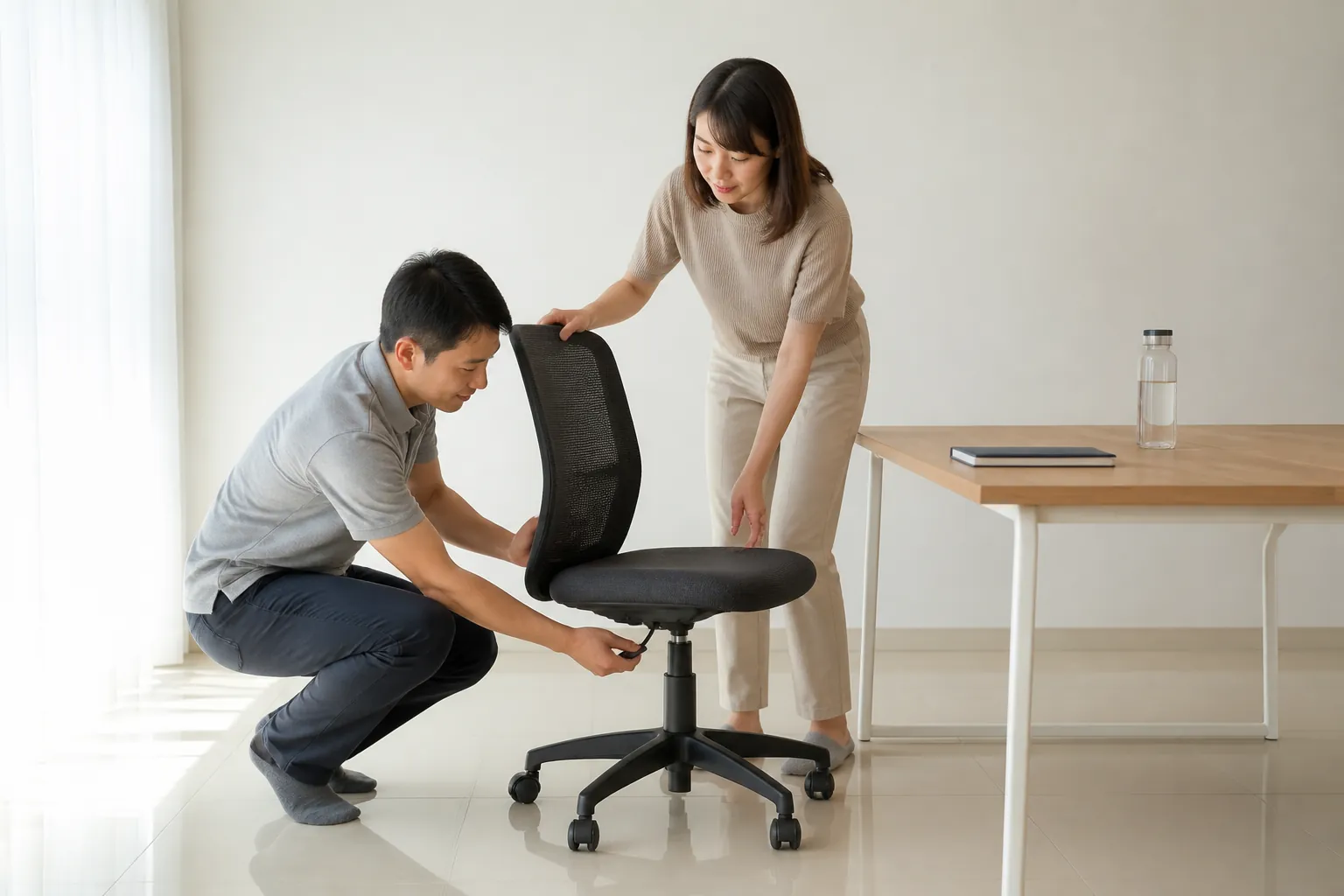
- Adjustable chair with proper seat height (knee at 90 degrees, feet flat)
- Under-desk foot rest to vary leg position
- Proximity to bathroom and break room (reduce unnecessary walking in early weeks)
- Elevator access if workplace has stairs
Standing workers (retail, hospitality, teaching):
- Anti-fatigue mat at primary workstation
- Perching stool for rest breaks
- Graduated standing schedule (30 minutes standing, 15 minutes seated, progressing)
- Appropriate footwear with knee-supporting properties
Physical workers (warehouse, construction, manufacturing):
- Mechanical aids for lifting (trolleys, hoists, conveyors)
- Job rotation to alternate knee-loading and non-loading tasks
- Modified workstation heights to eliminate deep squatting
- Non-slip flooring in work area
- Task restructuring: redistribute heavy tasks to colleagues temporarily
Phase 4: Functional Capacity Evaluation
For physically demanding jobs, the OT conducts a Functional Capacity Evaluation (FCE), a standardised assessment that objectively measures your ability to perform job-specific physical tasks:
What’s tested:
- Lifting capacity (floor to waist, waist to shoulder, overhead)
- Carrying capacity (distance and weight)
- Push/pull force
- Sustained standing and walking tolerance
- Stair climbing ability
- Kneeling, squatting, and crouching tolerance
- Sustained posture tolerance
Duration: 2-4 hours of standardised testing.
Cost: RM400-800 for a full FCE.
Who uses the results: The employer (to confirm fitness for duty), SOCSO (for claim resolution), the surgeon (for clearance), and you (to know your actual capacity).
SOCSO and Return-to-Work
If your ACL injury occurred at work or during commuting, SOCSO’s Return to Work (RTW) programme applies:
- SOCSO assigns a case manager who coordinates between you, your employer, your surgeon, and your OT
- The OT’s return-to-work plan is submitted to SOCSO as part of the rehabilitation programme
- SOCSO covers rehabilitation costs including OT (under the RTW programme)
- Temporary disablement benefits cover income loss during recovery (80% of average daily wages)
SOCSO RTW contact: Call 1-300-22-8000 or visit any SOCSO office to register for RTW.
Cost
| Service | Cost |
|---|---|
| Job demands analysis | RM 200 – RM 400 |
| Return-to-work programme (6-8 sessions) | RM 120 – RM 200/session |
| Workplace assessment (on-site) | RM 300 – RM 600 |
| Functional Capacity Evaluation | RM 400 – RM 800 |
| SOCSO-covered RTW programme | RM0 (covered by SOCSO) |
Frequently Asked Questions
Can my employer force me back to work before the OT clears me? No. Under the Employment Act 1955 and the Occupational Safety and Health Act 1994, an employer cannot require a worker to perform tasks that exceed their documented medical capacity. The OT’s return-to-work report serves as medical documentation of your current capacity.
I have a desk job. Do I really need OT for ACL recovery? Even desk workers benefit from OT for workstation setup (chair height, under-desk clearance for the braced knee), graduated return planning (full days are exhausting when you’re still in recovery), and managing the commute (driving clearance, parking proximity, stair avoidance).
My ACL surgery was 6 months ago and I still can’t kneel. Is that normal? Kneeling tolerance varies significantly after ACL reconstruction. A 2020 study in Knee Surgery, Sports Traumatology, Arthroscopy found that 40% of patients had ongoing kneeling difficulty at 12 months. The OT can assess whether this is normal healing, scar tissue restriction, or quadriceps weakness, and treat accordingly.
Surgery Fixes the Ligament. OT Gets You Back to Your Job.
The graft heals in its own time. But your return to work depends on matching your recovery stage to your job demands, and that’s a clinical skill. Don’t guess when you’re ready. Get assessed.
Chat with us on WhatsApp to plan your return to work after ACL surgery, anywhere in Malaysia.